Skip to content
The People Who Trigger You Are Not Random
Some people irritate you more than the moment warrants. In this piece, Pooja Bedi explores emotional triggers, projection, old wounds and how to move from being hijacked by your buttons to quietly taking your power back.

There’s a person who gets under your skin.
You know the one. Maybe it’s a colleague whose particular brand of self-importance makes your jaw tighten. Maybe it’s a relative whose comments land like small darts every single time. Maybe it’s someone you barely even know, an acquaintance, a friend of a friend, whose way of being irritates you far more than any reasonable person should be irritated.
And here’s the tell. Your reaction is out of proportion. Other people find them mildly annoying at most. You find them genuinely activating. The irritation lingers. You replay the conversation. You vent about them to anyone who’ll listen. They occupy far more of your mental real estate than someone that unimportant has any right to.
We usually explain this away by deciding the other person is simply the problem. They’re difficult. They’re just like that. And sometimes, yes, people are genuinely difficult. But when your reaction is disproportionate, when it burns hotter than the situation warrants, something more interesting is happening. Because the people who trigger you are not random. And the intensity of your reaction is not only about them. It’s information about you.
The Mirror You Didn’t Ask For
Here is an idea I explore in LIMITLESS that changed how I understand every difficult person I’ve ever met.
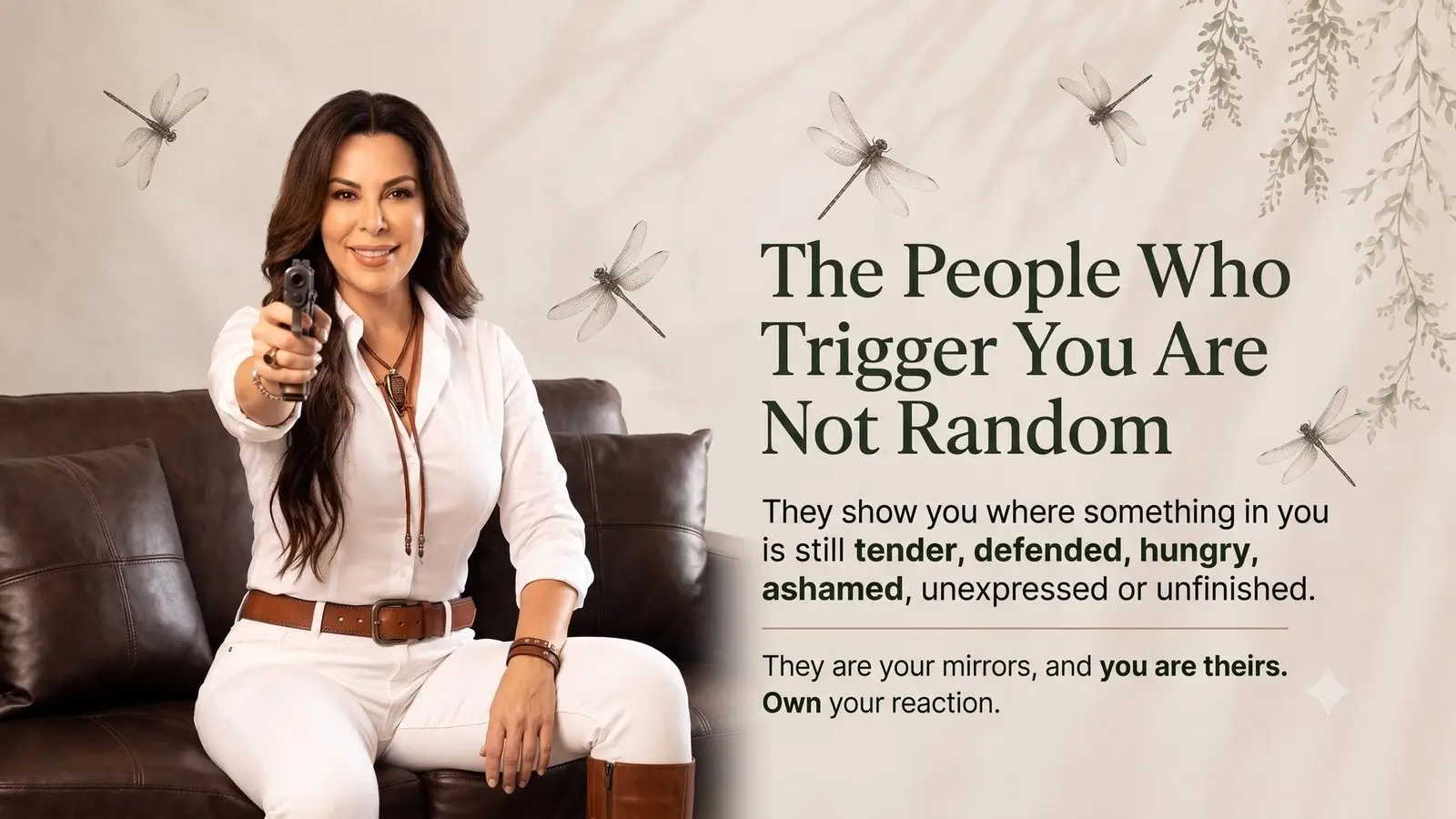
Some people come into your life like mirrors you did not ask for. Not to punish you. Not to expose you. But to show you where something in you is still tender, defended, hungry, ashamed, unexpressed or unfinished.
The lazy person who infuriates you may be holding up a mirror to how much you overwork and cannot allow yourself to rest. The arrogant one who gets under your skin may be reflecting the part of you that quietly longs to take up more space and doesn’t feel permitted to. The person whose neediness exhausts you may be showing you your own difficulty with dependence, your own unmet needs you learned to bury. The one whose boundaries you find rude may be revealing how much you struggle to set your own.
Sometimes this is projection, the mind’s way of noticing in someone else what we have not yet faced in ourselves. Sometimes it is an old wound being pressed. Sometimes it is envy, grief, fear, resentment or a boundary your body recognised before your mind did. The point is not to reduce every trigger to one explanation. The point is to become curious about why this particular person has this much power over your inner weather.
It works in the direction of your growth, too. If someone praying for patience isn’t handed patience but handed a traffic jam, an infuriating colleague, a slow queue, then perhaps the people who test you most are simply your unfinished lessons wearing a human face. The draining relationship that teaches you to love yourself first. The person who oversteps, teaching you to finally build a boundary. In ordinary life, the trigger can become curriculum.
Let me be very clear about one thing, because it matters. This is about everyday irritation, emotional reactions and growth. It is not about excusing genuine mistreatment. If someone is abusing, threatening, coercing or harming you, that is not a mirror you need to gaze into more deeply, and it is certainly not your lesson to decode. Some people are causing harm. The healthy response is distance, boundaries and support, not endless introspection.
Why Your Body Reacts Before You Can Think
There’s a reason triggers feel so overwhelming, and it isn’t weakness. It is biology.
When something feels threatening, even emotionally threatening, your nervous system can move into protection mode before your thinking mind has caught up. The amygdala, one of the brain’s threat-detection systems, becomes involved in scanning for danger, while the calmer, more reflective parts of you become harder to access in that moment. Which is why one sharp tone, one dismissive comment, one person who reminds you of an old wound can suddenly feel much bigger than the present situation.
There’s an evolutionary logic to this. Noticing the threat kept our ancestors alive, so the brain became exquisitely tuned to danger, storing pain and criticism more readily than praise. The trouble is that we are no longer running from predators, but the alarm system hasn’t quite received the memo. It still treats a critical remark or a person who echoes an old hurt as though survival itself were at stake.
This is why you can know, intellectually, that a person is not worth your energy and still find yourself hijacked by them. The reaction is not happening in the thoughtful, wise, well-hydrated version of you. It is happening in the alarm system, below thought, before choice. Which is precisely why willpower alone rarely works. You cannot scold a nervous system into safety. You have to pause long enough to show it that this moment is not the old danger.
Taking Your Remote Control Back
Here is where everything shifts, and it’s the difference between a life of reaction and a life of response.
Your conditioning taught you to react. Every trigger, every button pressed, every disproportionate flare of irritation, that’s the old programming running automatically. But there is another way, and it begins the moment you stop asking what is wrong with them and start asking what is this reaction showing me.
That single question changes everything. It moves you from victim to student. Instead of being at the mercy of whoever happens to press your buttons, you become curious about why you have that particular button in the first place. And a button you understand is a button that slowly loses its power.
There is a world of difference between reacting and responding. Reaction stems from habit and conditioning. It’s automatic, unconscious, and usually something you regret. Response is deliberate, mindful and present. It’s the pause between the trigger and your reply, the small sacred gap where your power actually lives. As I say in LIMITLESS, the goal is to get familiar with your own buttons so that others can no longer press them, and when they try, you can choose to respond rather than react.
So the next time someone triggers you, before you fire off the reply, before you spiral into the story, try this. Pause. And instead of asking why they are like that, ask yourself: why does this particular thing land so hard in me? What is it touching? What might it be trying to show me?
You may not like the answer at first. But somewhere in it is a piece of your own freedom. Because the moment you can see the mirror clearly, the person holding it up loses their power over you. They become, of all things, a slightly irritating teacher. And you get your remote control back.
Learning to understand your triggers, regulate your nervous system, and move from reaction to conscious response is some of the most liberating work in LIMITLESS.
Frequently Asked Questions (FAQs)
Why do certain people trigger me so much?
Because your strongest triggers are rarely random, and they’re usually not only about the other person. When your reaction to someone is disproportionate, burning hotter than the situation warrants, it’s often because they’re reflecting something unresolved in you, a trait you haven’t accepted, a wound they’re unknowingly pressing, or a boundary your body sensed before your mind did. The intensity of your reaction is information. It’s pointing at something in you that’s ready to be seen, understood and eased.
What does it mean when someone triggers you?
It usually means they’re touching something within you that wants attention. Sometimes it’s projection, noticing in them a trait you haven’t faced in yourself. Sometimes it’s an old wound being pressed, activating fear, grief or insecurity from an earlier time. Sometimes it’s envy, or a boundary being crossed that your body registered instantly. A trigger is essentially your nervous system flagging unfinished emotional business. It feels like it’s about them, but the lasting value comes from turning the question inward and asking what the reaction is revealing.
How do I stop reacting to people who upset me?
Start by understanding that reaction happens in the nervous system, below conscious thought, which is why willpower alone rarely works. When something feels threatening, your body can move into protection mode before your reflective mind catches up. The shift from reaction to response begins with the pause, the small gap between the trigger and your reply where your power lives. Practising nervous system regulation, noticing your physical cues, and asking what the reaction is showing you rather than what’s wrong with them gradually puts your remote control back in your own hands. It’s a practice, not an overnight switch.
Is being triggered always about my own issues, or is it sometimes the other person?
Both can be true, and it’s important not to weaponise this idea against yourself. Sometimes people are genuinely difficult, and sometimes they are genuinely harmful, and in those cases the healthy response is distance, not endless self-examination. The mirror principle applies to everyday triggers, the disproportionate irritations of ordinary life, not to abuse or mistreatment. A useful test is intensity: if your reaction is far larger than the situation warrants, there’s usually something in you worth exploring. If someone is actually harming you, that’s not a lesson to decode. That’s a boundary to set.
Can understanding my triggers actually change my relationships?
Yes, and often profoundly. When you stop outsourcing your emotional reactions to other people’s behaviour and start understanding what’s driving them in you, you become far less controllable by others and far more at peace within yourself. You may stop participating in the same dynamic on repeat, because you are no longer reacting from the same unresolved charge. And you respond to people from choice rather than reflex, which transforms how conflict unfolds. The irony is that the deepest relationship work often happens inside you, not in the conversation with the other person.
LIMITLESS is a transformative 12-week self-paced online course by Pooja Bedi, designed to help you reprogram your mind, overcome limiting beliefs and unlock your highest potential. Blending practical tools from NLP, clinical hypnosis, mindfulness, energy sciences and holistic wellness, the course empowers you to build confidence, cultivate a positive mindset and create lasting personal transformation. With engaging video lessons, guided meditations, exercises and access to a supportive community, LIMITLESS offers a step-by-step journey toward living with greater clarity, purpose, abundance and happiness.