Skip to content
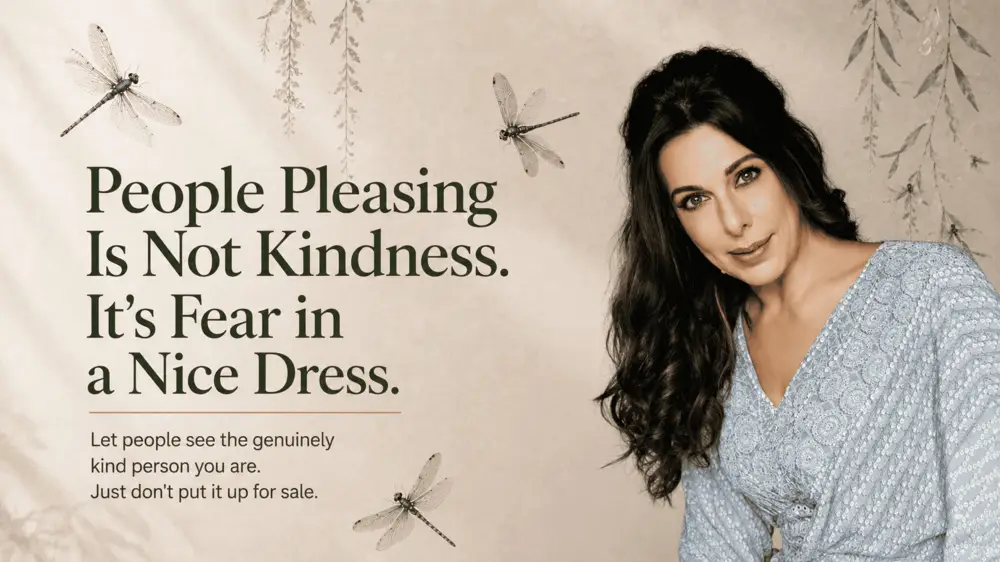
People Pleasing Is Not Kindness. It’s Fear in a Nice Dress.
We've dressed people-pleasing up as kindness, generosity, being a good woman. It's none of those things. In this piece, Pooja Bedi draws on personal experience and her LIMITLESS framework to reveal the fear beneath the pattern, where it comes from, and how to set boundaries that come from self-respect rather than guilt.

Years ago, while researching human behaviour for a column, I came to an alarming conclusion about myself.
I was a people-pleaser.
Not in the abstract, someone-else-has-this-problem way. In the uncomfortable, oh-this-is-me way. Because as I read through the patterns, the symptoms, the tells, I kept recognising my own choices staring back at me. The reflexive yes. The chronic overcommitment. The bending over backwards to make difficult, self-centred people feel better about themselves while quietly abandoning myself in the process.
And here is what I’ve learned since, both in my own life and in the years of work that followed: people-pleasing is one of the most misunderstood patterns there is. We’ve dressed it up as kindness. As generosity. As being a good person, a good woman, a good daughter, a good wife, a good friend.
It is none of those things. Or rather, it is those things wearing a disguise. Underneath the disguise is something far less comfortable to look at.
It’s fear.
The Symptoms You’ve Been Calling Virtues
See if any of these sound familiar.
You make a habit of saying yes when everything in you wants to say no. You worry constantly about hurting other people’s feelings, often to the point of neglecting your own. You have a never-ending time management problem, because your time is never quite your own. You jump to volunteer, especially for the jobs nobody else will touch. You rarely, if ever, ask for help or accept it when offered. You are willing to bend over backwards for unhappy, controlling people. You are extremely critical of yourself. And you feel guilty, genuinely guilty, when you haven’t managed to make everyone around you happy.
If you read that list and felt a flicker of recognition, you are in very good company. The author of this blog included.
How many dinners have you said yes to when your body was begging for sleep? How many weddings have you attended because saying no felt harder than simply going? How many times has sure, no problem left your mouth while something inside you quietly deflated?
Here is the crucial distinction, and it’s one I want you to sit with. There is a profound difference between being helpful and being a people-pleaser. One comes from caring. The other comes from fear and self-esteem issues. When you help from a full heart, you give freely and you receive appreciation, gratitude and reciprocity in return. When you please from fear, you are not really giving at all. You are buying. Buying safety, buying approval, buying your place in the room. And on some level, everyone can feel the difference.
Let people see the genuinely kind person you are. Just don’t put it up for sale.
Where the Fear Actually Comes From
People-pleasing is not a personality trait you were born with. It is a survival strategy you learned, usually early, usually in response to an environment where your safety, your belonging or your sense of being loved depended on keeping someone else happy.
In LIMITLESS Module 3, I map a defence mechanism I call Altruistic Surrender, prioritising others so completely that you never have to focus on yourself. It is the parent who says I live only for my children, their happiness is my happiness, while quietly having no idea what their own happiness would even look like anymore. It looks like devotion. It looks like selflessness. From the outside it looks almost saintly.
From the inside, it often feels like exhaustion. Because underneath it is frequently a person running from the emptiness of their own unmet needs, unlived dreams and unspoken wants. Living for others becomes a way to avoid the far more frightening task of living for yourself.
I remember attending a workshop years ago based on the book How Women Rise by Marshall Goldsmith and Sally Helgesen. The very first habit they identified as holding women back was something they called the Disease to Please. I remember smiling, because it finally had a name. Women, at great personal cost, constantly trying to prove how wonderful they are, scoring invisible brownie points with in-laws, bosses, children, friends, neighbours, anyone whose approval might confirm that they matter. It is wonderful to be liked. But when being liked comes at the cost of your needs, your health, your dreams and your sense of self, a natural desire to please has quietly curdled into a disease.
And the cruel irony is this: what you think is designed to make you rise is eventually responsible for making you fall.
The Opposite of People-Pleasing Is Not Selfishness. It’s Honesty.
This is the fear that keeps most people trapped, the belief that if they stop pleasing, they’ll become cold, self-centred, unkind. They won’t. The opposite of people-pleasing is honesty. It is boundaries. It is the radical, terrifying, liberating act of saying no.
Our entire programming from childhood, particularly for women, particularly in our culture, is to bend. To think of others before ourselves. To earn good karma by giving and giving and giving. But here is something we are rarely taught: it is also good karma to be good to yourself. You too deserve rest, respect, pampering and care. Saying no is not unkind. It is one of the highest forms of self-respect there is.
And the way you say it matters as much as the saying. A boundary is not an attack. It is simply information. This doesn’t work for me. I’m not available for that. I need some time. No blame. No finger-pointing. No lengthy paragraph of justification designed to soften a perfectly reasonable no into something more palatable. If saying no straight away feels impossible, begin with a buffer. Let me think about it and get back to you. It gives you room to breathe and sets the stage for a no that doesn’t have to be defended.
You will feel guilty at first. Expect it. The guilt is not a sign you’ve done something wrong. It is simply the old programming protesting the new behaviour. It passes. And on the other side of it is something you may not have felt in years. A life that is actually your own.
Because if you are not willing to stand up for yourself, why would you expect anyone else to do it for you?
If you want to understand where your people-pleasing began, identify the fear underneath it and learn to set boundaries that come from self-respect rather than guilt, that is exactly the work we do together in LIMITLESS.
Frequently Asked Questions (FAQs)
What is the difference between being kind and being a people-pleaser?
Kindness comes from a full heart. People-pleasing comes from fear. When you are genuinely kind, you give freely because you want to, and you feel good afterwards. When you are people-pleasing, you give because you are afraid of what happens if you don’t, the disapproval, the conflict, the possibility of being seen as difficult or unkind, and you often feel depleted or resentful afterwards. The behaviour can look identical from the outside. The difference is entirely in the internal experience. If saying yes brings relief from anxiety rather than genuine warmth, that is people-pleasing, not kindness.
What are the signs that I’m a people-pleaser?
The clearest signs are saying yes when you want to say no, worrying constantly about disappointing others, struggling to ask for or accept help, feeling responsible for everyone else’s happiness, and experiencing genuine guilt when you haven’t managed to make everyone around you happy. Other strong signals include over-volunteering for tasks nobody else wants, being far harder on yourself than you would ever be on others, and a persistent sense that your time is never quite your own. If several of these feel familiar, you are very likely running a people-pleasing pattern that you may have mistaken for simply being a good person.
Why do I feel so guilty when I say no?
Because your guilt is old programming, not moral truth. Most of us, particularly women, were conditioned from childhood to bend, to put others first, and to earn approval through giving. When you begin saying no, that conditioning protests, and it shows up as guilt. This does not mean you have done something wrong. It means you are doing something new. The guilt is simply the nervous system reacting to an unfamiliar behaviour that it has been trained to see as dangerous. With practice, it loses its grip, and saying no begins to feel less like a betrayal and more like self-respect.
Can people-pleasing be unlearned?
Yes, completely, though it takes awareness and practice rather than willpower alone. People-pleasing is a learned survival strategy, which means it can be unlearned the same way it was installed, gradually and through repetition. The work begins with recognising the pattern, understanding the fear underneath it, and then practising small acts of honesty and boundary-setting that feel safe enough to sustain. Each time you say no and discover that the relationship survives, the old belief weakens a little more. Over time, choosing yourself stops feeling like a risk and starts feeling like home.
Is people-pleasing linked to low self-worth?
Yes, very closely. People-pleasing often grows from a belief that your worth is conditional on how useful, agreeable or accommodating you are. If somewhere along the way you learned that you are valued for what you do for others rather than for who you are, pleasing becomes a way to secure love and belonging that you don’t believe you’d receive otherwise. This is why genuine change involves more than just learning to say no. It involves rebuilding your sense of worth from the inside, so that you no longer need to earn your place through self-abandonment.
LIMITLESS is a transformative 12-week self-paced online course by Pooja Bedi, designed to help you reprogram your mind, overcome limiting beliefs and unlock your highest potential. Blending practical tools from NLP, clinical hypnosis, mindfulness, energy sciences and holistic wellness, the course empowers you to build confidence, cultivate a positive mindset and create lasting personal transformation. With engaging video lessons, guided meditations, exercises and access to a supportive community, LIMITLESS offers a step-by-step journey toward living with greater clarity, purpose, abundance and happiness.