Skip to content
Boundaries Aren’t Walls. They’re Architecture.
Most people imagine a boundary as a wall, something hard and cold, which is exactly why warm, giving people resist setting them. In this piece, Pooja Bedi reframes boundaries as architecture, explores the difference between resentment and self-respect boundaries, and reveals the mistake that quietly leaves people isolated.


Say the word “boundary” and watch what most people picture.
A wall. Something hard. Something cold. A barrier you throw up to keep people out, to shut them down, to protect yourself by becoming a little less available, a little more guarded, a little more armoured than you were before.
And this, I think, is exactly why so many warm, loving, generous people resist setting boundaries at all. Because they’ve been told boundaries are walls, and they don’t want to become the kind of person who builds walls. They fear that protecting themselves means hardening themselves. That saying no means becoming someone who no longer says yes to anything. That drawing a line makes them cold.
So they don’t draw the line. They keep saying yes. They keep over-giving. They keep quietly resenting it. And they call this being loving, when really it is love without structure.
Because here is what took me years to understand. A boundary is not a wall. A boundary is architecture. It’s the structure that holds your life up, and quietly shapes how people are able to move through it.
Instructions, Not Barricades
Think about a beautiful building for a moment. It has walls, yes, but that’s not what makes it beautiful or functional. What makes it work is the design. The doorways that invite people in. The windows that let the light through. The rooms arranged so that life can actually happen inside them. The structure doesn’t exist to keep the world out. It exists to hold something precious up.
That’s what a healthy boundary actually is. As I teach in LIMITLESS, boundaries are not about keeping people out. They are about teaching people how to be in your life.
And here’s something that will change how you see this entirely. People do not always know your boundaries by instinct. Some will respect them the moment they’re clear. Some will test them. Some will ignore them entirely, and that says something about them, not about how well you explained yourself. But when you leave the blueprint completely blank, people often fill in the space however suits them, and then you find yourself resentful that they walked through a door you never actually decided to close. The absence of a boundary is itself an instruction. It quietly says: this is available, help yourself.
So a boundary, properly understood, is not an act of aggression. It’s an act of clarity. “This doesn’t work for me.” “I’m not available for that.” “I need some time.” These are not attacks. They are simply the architecture of your life, made visible, so that the people who love you know how to move through it with care.
The Two Kinds of Boundaries (And Why One Feels Awful)
Here is a distinction I draw in LIMITLESS that I wish someone had taught me decades ago, because it explains why setting boundaries so often feels terrible.
There are two kinds of boundaries. Resentment boundaries and self-respect boundaries. And they feel completely different, both to set and to receive.
A resentment boundary is what happens when you wait too long. You take on the role, the caretaker, the fixer, the pleaser, the strong one. You over-explain, over-justify, over-accommodate. You give and give past your own limit, silently resenting it the whole time. And then one day you hit your edge and you snap. “I’ve had enough.” The boundary arrives late, hot & dressed as punishment. It hurts the other person because it was meant to, a little. And it hurts you too, because it came from depletion rather than clarity.
A self-respect boundary is different entirely. It’s set early, calmly, before the resentment has a chance to build. It comes not from “I’ve had enough of you” but from “this is what works for me.” The intention is not to punish anyone or make them feel rejected. The intention is simply to teach people how you would like to be treated. It’s clean. It’s free of frustration. It isn’t dramatic, because it doesn’t need to be.
The difference isn’t in the words. It’s in the timing and the source. A boundary set from self-respect protects the relationship. A boundary set from resentment detonates it.
I once sat with a friend when her phone rang. She answered warmly, then after a moment said, lightly, “Oh, I forgot I only exist when you need something.” She explained she couldn’t do what was being asked, and then said, without a trace of anger, “I’m just going to love myself enough to hang up.” And she did. I braced myself for the flood of hurt and irritation to follow. It never came. She smiled, lighter rather than harder, and said, “That’s one more place where I’ve stopped abandoning myself.” She wasn’t building a wall out of rage. She was doing architecture, calmly, from self-respect. And she looked freer for it.
The Part Almost Everyone Gets Wrong
Here is where I need to say something that most boundary advice completely ignores, and it’s the reason this matters so much.
In learning to set boundaries, a lot of people quietly overcorrect. Having spent years being too available, too soft, too accommodating, they swing hard the other way. They become rigid. Dismissive. Detached. They cut people off at the first friction, decline every request on principle, and call it growth.
But that isn’t growth. That’s protection curdling into isolation.
Because here is the truth that holds the whole thing together: boundaries without sensitivity create isolation, and sensitivity without boundaries creates exhaustion. You need both. Not everything requires a boundary. Some things require understanding. Some require context. Some require compassion, patience, the benefit of the doubt. If you build boundaries without any sensitivity, you may successfully protect your peace, but you’ll slowly lose your connection, and human beings are not designed to live disconnected.
The goal was never to wall yourself off from everyone who might ask something of you. The goal is to build a life with a clear, warm structure. Doors that open to the people who treat you well. Rooms that have space for genuine giving. And walls, yes, where walls are genuinely needed, but placed with intention rather than flung up in anger.
One honest note, because it matters. There are situations where a boundary is not a sentence but an exit. If you are dealing with genuine harm, abuse, coercion or fear, the boundary you need may be distance itself, and that is beyond what any blog can hold. Please reach for real support in those cases. Some structures are not meant to be renovated. They are meant to be left.
For everything else, start small. Choose one place in your life where you’ve left the blueprint blank and quietly resented who wandered in. And instead of waiting until you snap, draw the line now, early, calmly, from self-respect rather than rage. Not to keep anyone out. To teach them, and yourself, how you deserve to be treated.
Learning to build boundaries from self-respect rather than resentment, and to hold them with sensitivity rather than rigidity, is part of the relationship work inside LIMITLESS. Because freedom is not only about saying no. It is about knowing what kind of yes your life can safely hold.
Frequently Asked Questions (FAQs)
What is the difference between a boundary and a wall?
A wall is built to keep people out. A boundary is built to teach people how to be in your life. A wall comes from fear and shuts everyone out indiscriminately, creating distance. A boundary comes from self-respect and creates clarity, letting the right people know exactly how to treat you while keeping the door open to genuine connection. That’s the crucial difference: walls isolate you, while boundaries actually protect your relationships by making your needs visible instead of leaving people to guess and inevitably get it wrong.
How do I know if I have healthy boundaries?
The clearest sign of a healthy boundary is that it comes from self-respect rather than resentment, and it’s set calmly and early rather than exploding out of you after you’ve had enough. If you find yourself over-explaining, over-justifying, silently seething, and then snapping, those are resentment boundaries, and they tend to arrive too late and land too hard. Healthy boundaries feel clean rather than dramatic. Another good sign is that you can hold your limits while still staying warm and connected, because a boundary that has hardened into coldness has quietly become a wall.
Why do I feel so guilty setting boundaries?
Because most of us, particularly women, were programmed from childhood to bend, to put others first, and to earn approval by giving endlessly. So when you start honouring your own limits, that old conditioning protests, and it shows up as guilt. This does not mean you’re doing something wrong. It means you’re doing something unfamiliar. The guilt is simply the old programming reacting to new behaviour. With practice it fades, and setting a boundary begins to feel less like a betrayal of others and more like an act of self-respect, which is exactly what it is.
Can you set boundaries without pushing people away?
Yes, and this is the part most people miss. The secret is holding boundaries and sensitivity together rather than trading one for the other. Boundaries without sensitivity create isolation, and sensitivity without boundaries creates exhaustion. A well-set boundary isn’t cold or punishing. It’s honest, warm and clear, and it actually strengthens good relationships because the people who love you would rather know your real limits than accidentally keep crossing them. Not everything requires a boundary. Some things simply need understanding. Wisdom is knowing which is which.
How do I start setting boundaries if I’ve never been able to?
Start small and start early, before the resentment builds. Choose one low-stakes situation and practise a clean, simple line like “that doesn’t work for me” or “let me think about it and get back to you.” Notice that you don’t need to over-explain, justify or apologise for having a limit. The way you say it matters as much as the saying, so aim for calm, kind and clear rather than aggressive or defensive. Each time you hold a small boundary and the relationship survives, the old fear loosens a little, and it gradually becomes easier to build the structure your life actually needs.
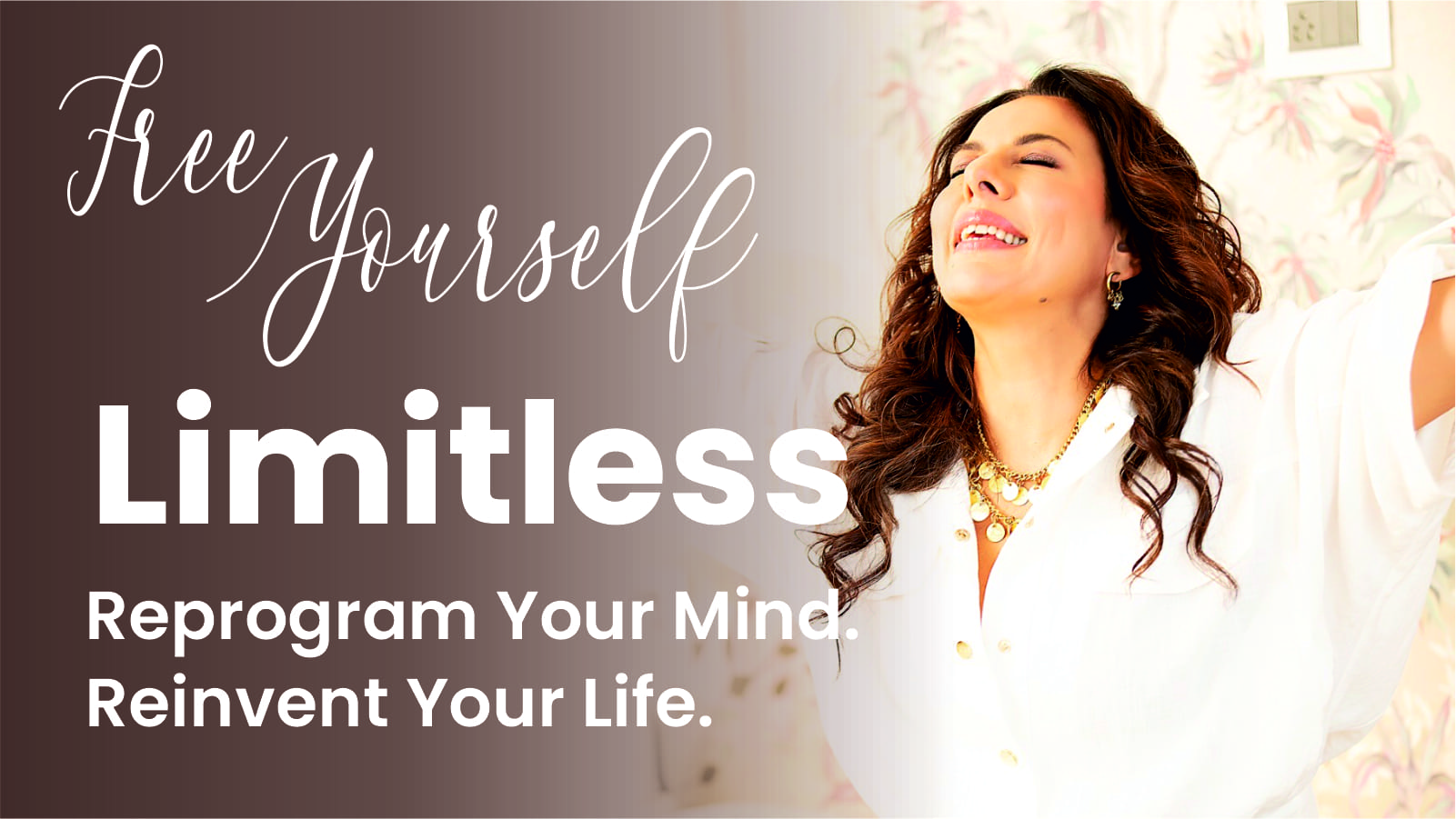
LIMITLESS is a transformative 12-week self-paced online course by Pooja Bedi, designed to help you reprogram your mind, overcome limiting beliefs and unlock your highest potential. Blending practical tools from NLP, clinical hypnosis, mindfulness, energy sciences and holistic wellness, the course empowers you to build confidence, cultivate a positive mindset and create lasting personal transformation. With engaging video lessons, guided meditations, exercises and access to a supportive community, LIMITLESS offers a step-by-step journey toward living with greater clarity, purpose, abundance and happiness.