Skip to content

Your Body Knew Before You Did
You feel it before you can name it, the tight chest, the clenched jaw, the knot in your stomach. In this piece, Pooja Bedi explores the mind-body connection at the heart of her healing work, how emotional stress settles into the body, and why the solution lives in the body too, through the breath and the nervous system rather than the thinking mind.


Notice where you’re holding it.
Go on, I’ll wait. The shoulders that have quietly migrated up towards your ears. The jaw you didn’t know was clenched until I mentioned it, and now suddenly can’t stop noticing. The breath sitting high and shallow in your chest, when did you last take a proper one? The knot in your stomach that showed up this morning before you’d even had your chai, carrying a worry your mind hadn’t got around to naming yet.
Your body knew before you did. It always does. It’s rather annoying that way.
We love to imagine we are brilliant minds being chauffeured around by slightly inconvenient bodies, two separate departments that occasionally email each other. We are not. Whatever goes on in that magnificent, overthinking mind of yours speaks through your body, constantly, fluently, in a language almost nobody taught us to read. That stress you’re managing so beautifully, so competently, with such an admirable smile? Your body isn’t fooled. It’s been quietly filing every bit of it away in your muscles, your gut, your breath, your nervous system. Keeping receipts. Your body is the most honest record-keeper you will ever meet, and frankly, it tells on you.
But here’s the part I actually want you to hold onto. If the body keeps the score, the body also holds the solution. The thing recording all your stress is the same thing that knows how to release it. You just have to learn to speak its language.
The Body Is Trying to Tell You Something
There is an entire tradition of healing built on one deceptively simple idea. Our emotional patterns don’t just rattle around in the mind. They move in. They take up residence in the body, unpack their bags, and stay.
Louise Hay, whose work has been foundational to my own, spent decades mapping which emotional states tend to settle into which parts of the body. In her world, the body isn’t malfunctioning at random, it’s delivering a message you haven’t opened yet. Long-held bitterness, the sense that life has quietly lost its sweetness, she linked to conditions like diabetes. The feeling of being suffocated, of not being able to fully breathe life in, she connected to the lungs. The legs, that ache between wanting to move forward and feeling unable to take the step. Barbara O’Neill and generations of natural healers have taught in the same spirit. The body is not your enemy. It’s your most loyal, most literal messenger, and it will keep repeating itself, louder each time, until you finally listen.
Now, let me be very clear about something, because this is where this kind of teaching can go badly wrong in careless hands. This is a lens for curiosity, not a cudgel for blame. It does not mean you gave yourself your illness, and it is absolutely not a reason to skip your doctor. The most beautiful healing I have ever witnessed happens when the emotional work and the medical work hold hands and walk in together, not when one smugly shows the other the door. So treat this as a gentle question, what might my body be carrying on behalf of my heart, asked while you also take your medicine and keep your appointments. Wisdom, not either-or.
Held that way, it becomes one of the most freeing ideas you’ll ever sit with. Because if feeling can settle into the body, then tending to that feeling becomes part of how you come home to yourself.
When Science Caught Up to the Mystics
And here’s what I love. This isn’t only ancient wisdom whispered over incense. Hard science has been quietly, almost sheepishly, catching up to what these teachers knew in their bones.
Take epigenetics, one of the most thrilling fields in modern biology. We used to think our genes were a life sentence handed down at birth, non-negotiable, no appeals. Turns out that’s not the whole story. You may inherit a propensity towards certain conditions, but epigenetics shows that your lifestyle, your environment and your stress levels help decide whether those genes ever get switched on or stay politely asleep. As the saying goes, your DNA may load the gun, but your life is often the finger hovering near the trigger. That’s peer-reviewed science, and it whispers something rather revolutionary. You were never just a passenger in your own biology.
Then, the water. You are roughly 60 percent of it, and your brain a startling 73 percent. You are, essentially, a very opinionated ocean in a nice outfit. The Japanese researcher Dr Masaru Emoto became famous for freezing water and photographing its crystals, and finding that water offered love and beautiful music formed exquisite, symmetrical jewels, while water subjected to anger and chaos froze into something broken and disfigured. Now, Emoto’s work lives at the poetic, experimental edge of all this rather than in the biology textbooks, and I share it exactly as he intended it, as a stunning meditation on intention, not a law of physics. But just sit with the image a moment. If a thought could do that to a glass of water, what on earth is your inner monologue doing to the vast, sloshing ocean that is you?
Whatever you decide about the crystals, the principle underneath is now beyond argument. Chronic stress leaves marks. Sustained cortisol meddles with your blood pressure, your immunity, your digestion, your sleep, your skin. Your repeated emotional states quietly become your body’s factory settings. Your body learns your patterns long, long before your mind catches on. It’s been taking notes this whole time. You just weren’t cc’d.
You Can’t Think Your Way Out of This One
Here is the part that quietly explains why so much self-help fails, why you can read all the books, underline all the wisdom, know all the right things, and still feel exactly the same on a Tuesday.
You cannot think your way out of a body that’s convinced it’s under attack. When your nervous system is in full fight-or-flight, your clever thinking brain is not exactly sitting at the head of the boardroom, calmly taking minutes. So every affirmation you fling at it just bounces off a system that does not, for one second, feel safe. As I teach in LIMITLESS, you cannot reprogram a tense system. Regulation comes first. And regulation doesn’t happen in your head. It happens in your body, or it doesn’t happen at all.
Which is exactly why the breath is such a quietly outrageous superpower. Something as unglamorous as box breathing, in for four, hold for four, out for four, hold for four, gently coaxes your body toward its relaxation response, working the vagal pathways that talk your system down off the ledge. No crystals required, no chanting, no retreat in the Himalayas. Just physiology you can run in ninety seconds, in a boardroom, in bumper-to-bumper traffic, at 3am when your brain has decided to host a film festival of every mistake you’ve ever made.
And the body has so many doors. A massage that releases oxytocin and lets your shoulders finally come down from your earlobes. Movement that burns off the anxious charge stuck in your muscles. Barefoot grass, morning sun, a proper glass of water, softening one clenched fist. This is what I call the Kaizen approach in LIMITLESS, one percent better every day, tiny, almost laughably small habits that slowly convince a frightened body it’s finally, actually safe.
So here’s your invitation, and this time it isn’t a thought. It’s a breath. Take one right now, slower and deeper than the last. Let the shoulders drop. Unclench the jaw, yes, that one. Find the knot and breathe into it instead of around it. There. You just spoke to your body in its mother tongue and told it the one thing it’s been waiting years to hear. It’s safe now. You can put some of this down.
Your body has been carrying the score for a very long time, uncomplaining, loyal, exhausted. It’s allowed to set some of it down. Learning to read what your body is holding, and to release it through the nervous system instead of arguing with it in your head, is at the very heart of the body work in LIMITLESS.
Frequently Asked Questions (FAQs)
What does it mean that the body keeps the score?
It means the stress, emotions and experiences you live through aren’t just handled by your mind, they get physically recorded and stored in the body, in your muscles, your breath, your gut and your nervous system. You’ll often feel an emotion in your body, a tight chest, a clenched jaw, a knot in the stomach, before your mind has even named it. Over time, repeated emotional states harden into physical patterns. The genuinely hopeful part is that because the body holds these patterns, the body is also where a great deal of the release and healing gets to happen.
Can emotions really cause physical symptoms?
Emotions and chronic stress absolutely influence the body, and this is increasingly well documented. Sustained stress keeps cortisol elevated, which affects blood pressure, immunity, digestion, sleep and inflammation over time. Many healing traditions, including the work of teachers like Louise Hay and Barbara O’Neill, go further and map particular emotional patterns to particular parts of the body as a tool for self-reflection. It’s essential to hold this as an empowering lens rather than a source of blame, and never as a replacement for medical care. Emotional wellbeing and good medical treatment work best hand in hand, not in place of one another.
How do I release stress that’s stored in my body?
Start with the breath, because it’s the fastest way to tell your nervous system it’s safe. Box breathing, in for four, hold for four, out for four, hold for four, activates the vagus nerve and helps ease the body out of fight or flight. Beyond breath, movement discharges trapped tension, massage and touch release oxytocin and soften stored stress, and small daily habits like hydration, sunlight and consciously unclenching your jaw or shoulders slowly teach the body to feel safe again. The key is that release happens through the body, not by thinking your way out of it.
Why doesn’t positive thinking alone fix how I feel?
Because you cannot think your way out of a nervous system stuck in survival mode. When your body is in fight or flight, your thinking brain isn’t fully online, so affirmations and insight just bounce off a system that doesn’t feel safe yet. This is why so much mental self-help quietly disappoints. Regulation has to come first, and regulation happens through the body, through breath, movement and release, which calms the nervous system enough that the mental work can finally take root. Body first, then mind. Not the other way around, however much we wish it were.
Is the mind-body connection actually backed by science?
Parts of it are firmly established, and parts live in the realm of healing philosophy and personal exploration. The effects of chronic stress on the body are well documented, and epigenetics has shown that lifestyle and environment influence how our genes express themselves. Other teachings, like detailed emotional maps of the body or Dr Masaru Emoto’s water-crystal experiments, sit at the more contemplative, experimental edge and are best held as meaningful frameworks for self-inquiry rather than settled laboratory fact. Both have real value. The wisdom is in taking the empowerment they offer while keeping good medical care firmly in the picture.
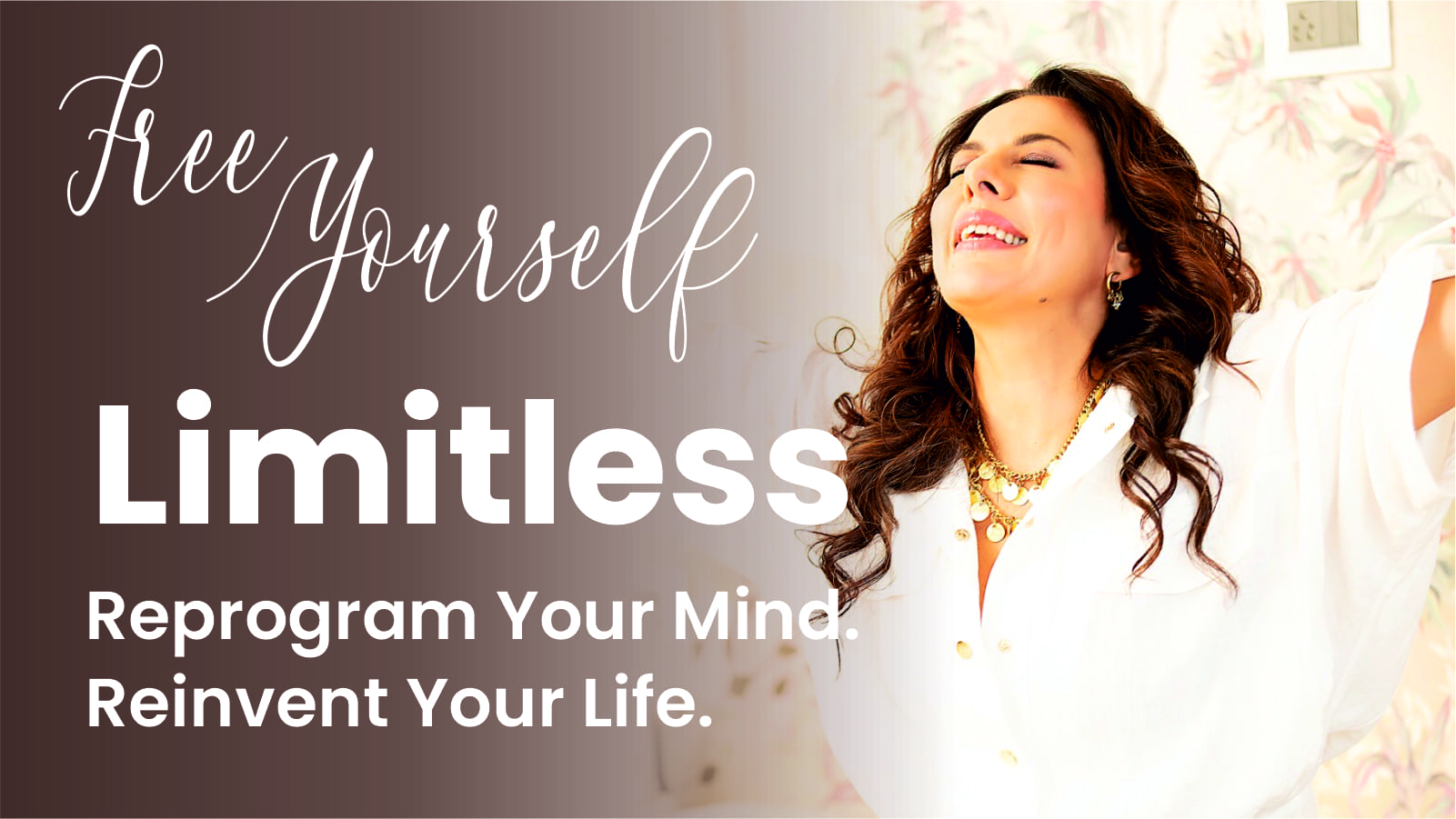
LIMITLESS is a transformative 12-week self-paced online course by Pooja Bedi, designed to help you reprogram your mind, overcome limiting beliefs and unlock your highest potential. Blending practical tools from NLP, clinical hypnosis, mindfulness, energy sciences and holistic wellness, the course empowers you to build confidence, cultivate a positive mindset and create lasting personal transformation. With engaging video lessons, guided meditations, exercises and access to a supportive community, LIMITLESS offers a step-by-step journey toward living with greater clarity, purpose, abundance and happiness.