Skip to content
You Were Never Broken. You Were Programmed.
You are not broken. You are programmed. Neuroplasticity confirms the brain can form new neural pathways at any age. Patterns installed in childhood through family, culture and experience can be identified and rewired through consistent subconscious reprogramming, not willpower or self-criticism alone.


What destroys iron?
Not pressure. Not weather. Not time.
Its own rust.
I’ve been sitting with that image for years, and every time I return to it I find something new. Because most of us spend our lives convinced that we are the iron that has been weakened by external forces. By difficult parents, by relationships that didn’t work, by failures we can’t quite forgive ourselves for, by the version of ourselves we were at twenty-two that we’re still somehow on trial for at forty-two.
We call ourselves broken. Damaged. Too much. Ugly. Unworthy.
And then we hand that verdict to a therapist, a coach, a self-help book, a new relationship, a wellness retreat and wait to be fixed.
The Rust You Didn’t Choose
In LIMITLESS Module 4, I talk about the most important relationship you will ever have… and it’s not the one you’re thinking of. It’s the one you have with yourself. And for most people, that relationship is the harshest, least forgiving, most relentlessly demanding one of all.
Think about it for a moment. Would you speak to a friend the way you speak to yourself? Would you tell someone you love that they’re stupid, lazy, too sensitive, too needy, not disciplined enough, not loveable enough, fundamentally flawed? Of course not. You’d be appalled if someone else said those things to them.
And yet the internal monologue runs. On a loop. Often from the moment you wake up.
I should have handled that better. I always do this. What is wrong with me.
This is the rust. Not the iron. The rust is the self-attack, the shame, the belief that you are inherently defective rather than simply, humanly, conditioned.
And here is the crucial distinction that changes everything: rust isn’t the iron’s nature. Rust is what happens when iron is exposed to certain conditions, oxygen, moisture, time, without protection. Remove those conditions, treat the surface, and the iron underneath is entirely intact.
You are the iron. The negative self-talk… the voice that says you should have known better, done better, been better… that is the rust. Not your nature. Environmental. Accumulated. And treatable. Negative self-talk isn’t the truth about who you are. It’s a weather condition you’ve been living in so long you’ve started to believe it’s the climate.
What the Neuroscience Actually Says
Here’s where it gets genuinely interesting. And where the science catches up with what ancient wisdom traditions have always known.
Your brain, as of this moment, is not fixed. Neuroplasticity, one of the most significant discoveries in modern neuroscience, confirms that the brain can form new neural pathways, rewire existing patterns, and genuinely change its default responses at any age. The structure you were handed is not the structure you are stuck with.
Research confirms that by age seven, your nervous system is largely shaped by syncing with the people who raised you. Their calm or their chaos became your blueprint. Their anxiety, their approval patterns, their relationship with money, their emotional range, all of it downloaded into you before you had the cognitive ability to evaluate any of it.
You didn’t choose the blueprint. But you have been living by it as though you did.
In LIMITLESS Module 7, I reference research showing that consistent negative self-talk literally hardwires the brain toward helplessness. The more you narrate your life as someone who always gets it wrong, who isn’t enough, who keeps failing, the more your neural pathways deepen that groove. Neuroplasticity works in both directions. It builds what you repeat. Which means the inner critic, left unchecked, isn’t just unpleasant. It’s actively reinforcing the prison.
And here is the part that most personal growth conversation glosses over: you cannot rewrite a program using the same program. You cannot think your way out of a pattern that wasn’t installed through thinking. The subconscious mind, which runs approximately 95% of your daily behaviour according to research in cognitive neuroscience, doesn’t respond to logic or willpower the way the conscious mind does. It responds to repetition, emotion, imagery, and experience.
This is why you can know, intellectually, that you are worthy of love… and still choose people who treat you as though you aren’t. Why you can understand, rationally, that rest is not laziness… and still feel guilty every time you sit down. Why you can list your achievements and still hear the voice that says it was luck, that they’ll find out, that it won’t last.
That voice isn’t your personality. It’s old code. And old code can be rewritten.
The Most Liberating Reframe I Know
In LIMITLESS, I describe the journey of deprogramming and reprogramming across twelve modules. But the single shift that makes everything else possible is this one: moving from what is wrong with me to what was I taught to believe about me.
That shift changes everything downstream.
The woman who over-apologises for existing isn’t broken. She was taught, somewhere early and somewhere repeatedly, that her presence was an inconvenience. The man who cannot rest without guilt isn’t lazy or undisciplined in reverse. He was taught that his worth was entirely conditional on his output. The person who cannot receive love without immediately waiting for it to be withdrawn isn’t damaged. They were taught, by experience, that love comes with conditions attached.
None of these are personality traits. They are learned responses. And what is learned can be unlearned. What is programmed can be reprogrammed.
I love this line from LIMITLESS Module 4: you don’t grow better by whipping yourself into improvement. You grow when your nervous system finally feels safe enough to change.
That’s it. That’s the whole thing. Not harder self-discipline. Not more self-criticism. Safety. The nervous system needs to feel safe before it will release a pattern, because that pattern, however limiting it looks from the outside, has been keeping it safe in the way it knows how.
So the invitation isn’t to attack the rust more aggressively. It’s to understand what conditions created it. And then, gently and deliberately, change those conditions.
Ask yourself one honest question today: what is one thing you have been calling a personality flaw that might actually be a learned response to a specific experience?
Just one. You don’t need to excavate your entire history in an afternoon.
And when you find it, try responding to it the way you would to a friend. With curiosity rather than contempt. With the understanding that the rust and the iron are not the same thing. And that underneath every pattern you’ve been fighting… the iron is completely intact.
If you want to go deeper into the actual process of deprogramming those patterns and reprogramming your mind with tools that work at the subconscious level rather than just the surface, that is the entire architecture of LIMITLESS.
Frequently Asked Questions (FAQs)
What does it mean to be programmed rather than broken?
It means that the patterns, beliefs, and behaviours that are causing you pain were not born with you. They were installed, through family, culture, experience, and repetition, before you had the awareness or the ability to question them. Being broken implies something is fundamentally defective. Being programmed means something was written into your system from the outside. And what was written from the outside can be rewritten from the inside. That distinction is the beginning of real self-compassion, and real change.
How do I know if my negative self-talk is programming rather than the truth?
Ask yourself whether you would say those things to someone you love. If the answer is no, that’s your signal. The inner critic rarely sounds like wisdom. It sounds like an old, frightened voice repeating a verdict that was handed to you long ago, usually by someone whose own programming was running the show. Truth is calm. Programming is relentless. If the voice is repetitive, disproportionate, and immune to evidence, it isn’t telling you the truth about yourself. It’s running a very old loop.
Can the brain actually be rewired, or is that just a motivational phrase?
It’s neuroscience, not motivation. Neuroplasticity is a well-documented phenomenon confirming that the brain can form new neural pathways and change its default patterns at any age. Research confirms that the nervous system, largely shaped in childhood, can learn a new program with consistent, targeted practice. This is not instant and it is not passive. It requires working with the subconscious mind through repetition, emotion, and experience, not just intellectual understanding. But the capacity for genuine rewiring is real, and it is available to you.
Why do I keep repeating patterns even when I know they’re not good for me?
Because knowing something consciously and changing it subconsciously are two entirely different processes. The subconscious mind, which drives the vast majority of your daily behaviour, doesn’t respond to logic or willpower in the way your conscious mind does. It responds to what feels familiar and safe, even when familiar and safe aren’t the same as healthy and happy. The pattern keeps repeating because it hasn’t been addressed at the level where it actually lives. Intellectual insight is the first step. Subconscious reprogramming is what creates lasting change.
What is the difference between self-forgiveness and making excuses for yourself?
Self-forgiveness is the practice of releasing the emotional weight of past mistakes without erasing accountability for them. It is not saying what happened was fine. It is saying that continuing to punish yourself for it is not making you better, it is making you smaller. As I explore in LIMITLESS Module 4, you do not grow by whipping yourself into improvement. You grow when your nervous system feels safe enough to change. Self-forgiveness creates that safety. Making excuses avoids accountability entirely. Self-forgiveness holds the accountability and releases the punishment. There is a significant difference between the two.
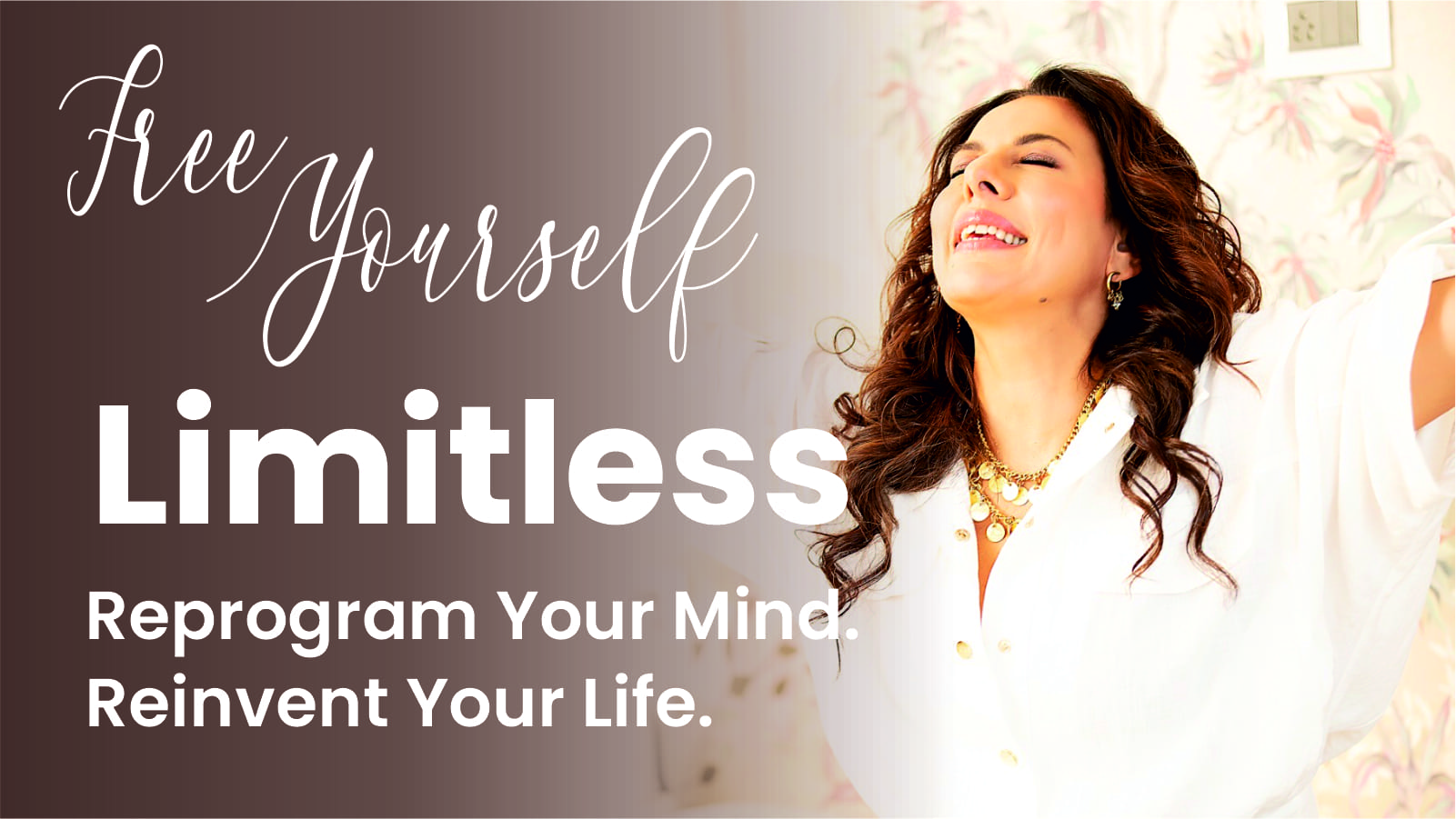
LIMITLESS is a transformative 12-week self-paced online course by Pooja Bedi, designed to help you reprogram your mind, overcome limiting beliefs and unlock your highest potential. Blending practical tools from NLP, clinical hypnosis, mindfulness, energy sciences and holistic wellness, the course empowers you to build confidence, cultivate a positive mindset and create lasting personal transformation. With engaging video lessons, guided meditations, exercises and access to a supportive community, LIMITLESS offers a step-by-step journey toward living with greater clarity, purpose, abundance and happiness.