Skip to content
Why You’re Exhausted (And It’s Not Because You’re Busy)
Most exhaustion isn't about doing too much. It's about leaking energy in directions that don't restore you. In this piece, Pooja Bedi maps three of the most common energy leaks from her LIMITLESS framework: the worthiness chase, people-pleasing, and resentment, and why addressing them changes everything.


You’ve walked into a room and felt it.
Not seen it. Not heard it. Felt it. Before a single word was spoken. Before anyone even looked up. A tension so thick it had its own texture. Or the opposite… a warmth, an ease, a sense of oh, I’m safe here that landed before you could explain why.
And then there are people. You know the ones. The person who walks through a door and the entire room shifts. Not because of what they said. Not because of how they looked. Something else entirely. Something invisible and entirely undeniable.
You weren’t imagining it. You were reading it. Because energy speaks before words do. And whether you know it or not, yours is speaking right now too.
But here’s the question I actually want to explore today. Not what you’re broadcasting, but what is quietly draining the signal before it even reaches anyone.
Because for most of the women I work with, the real problem isn’t that they don’t have energy. It’s that it’s leaking.
The Leak Nobody Talks About
In LIMITLESS Module 5, I introduce the concept of energy leaks: the chronic, low-grade patterns that quietly drain your power without you noticing. And the most insidious thing about them is that they don’t feel dramatic. They feel normal. They feel like you.
Energy leaks are not the obvious stuff. They are not the screaming fight or the sleepless night. They are the slow, steady drip. And like any drip, you don’t notice the damage until you look at the ceiling one day and realise the whole thing has gone soft.
There are three I see most consistently, and I’d be willing to bet you recognise yourself in at least one of them before we’re done.
Leak One: The Worthiness Chase
This one runs quietly in the background of almost every high-functioning person I know. It sounds like this:
Once I achieve this… then I’ll relax. When I’m better, more healed, more successful… then I’ll feel deserving. I’ll rest later. I’ll enjoy life once I’ve earned it.
In LIMITLESS, I call this the worthiness chase: an invisible race with no finish line, driven by an inner child who was taught, subtly or directly, that love is conditional, worth is deferred, and rest must be earned rather than deserved.
This is not a productivity problem. It is not a time management issue. It is emotional. And no amount of achieving will solve it, because the goalposts move every single time you get close. The moment you hit the target, the target shifts. Because the chase was never really about the goal. It was about trying to finally feel enough.
The energy cost is enormous. You cannot broadcast abundance from a frequency of chronic lack. And the worthiness chase is, at its core, a chronic lack frequency disguised as ambition.
The question worth sitting with: are you resting because you’ve earned it, or are you waiting to feel worthy enough to rest at all?
Leak Two: People-Pleasing
Every yes you say when your whole system means no is an energy leak.
Every explanation you offer when none was required. Every time you shrink yourself into a smaller version to fit a space that was never designed to contain you. Every apology for taking up room. Every carefully managed response designed to keep the peace at the cost of your own. Each one is a small withdrawal from an account that desperately needs depositing.
People-pleasing is one of the most socially rewarded energy leaks there is, which is precisely why it’s so hard to recognise as a problem. It looks like kindness. It looks like generosity. From the outside it looks like a personality trait worth admiring.
From the inside it feels like exhaustion with a smile painted on it.
As I explore in LIMITLESS, the worthiness chase and people-pleasing are deeply connected. When your sense of worth is tied to how much you give, how available you are, how little trouble you cause, your energy becomes a resource for everyone except yourself. You give your best to the room and come home running on vapour. And then you wonder why you’re tired.
The question: who gets your best energy… and who gets your leftovers?
Leak Three: Resentment
This one is the largest leak of all, and the least acknowledged.
Resentment is carrying a charge toward something that has already ended. The relationship that’s over but still lives rent-free in your nervous system. The colleague who got the credit you deserved, three years ago, whom you still think about with a particular tightening in your chest. The family member whose words from a decade ago still land in you like a stone every time you’re in the same room.
In LIMITLESS Module 5, I am very clear about this: forgiveness is not about the other person. It is about reclaiming your own energy. You cannot release what you still resent. You cannot move on while clinging to a wound that has already ended. The resentment keeps the energetic charge live long after the situation is over… and every time that charge activates, it is draining power from your present life and feeding it into something that is already finished.
Forgiveness is not forgetting. It is not excusing. It is not pretending it didn’t happen or didn’t hurt. It is the moment the past ceases to hold power over your present. It is deciding to stop bleeding energy into a wound that no longer needs to define you.
The question: what are you still carrying that has already ended?
The Moment the Drip Becomes a Flow
Here is what I find consistently true: most people aren’t exhausted because they’re doing too much. They’re exhausted because they’re leaking energy in directions that don’t restore them, and they have been for so long that the leak feels like their natural state.
The shift begins not with a dramatic overhaul but with awareness. Awareness of which of these three patterns is running most actively in your life right now. Awareness that the exhaustion has a source. And awareness that the source is not your circumstances, your workload, your age, or your personality.
It is a pattern. And patterns, as we’ve established across this entire series, can be changed.
Ask yourself honestly today: if someone walked into the room carrying your energy right now, what would they feel? Peace? Pressure? Scarcity? Resentment? Joy? Possibility?
Because whether you realise it or not, you are already broadcasting. The only question is whether you’re doing it consciously… or by default.
Addressing your energy leaks is some of the most practical and profound work in LIMITLESS Module 5. If you want to go through each one systematically, with real tools rather than just insight, that’s exactly where we do it.
Frequently Asked Questions (FAQs)
What are energy leaks and how do I know if I have them?
Energy leaks, as I map them in LIMITLESS Module 5, are the chronic patterns that quietly drain your power without dramatic warning signs. The most common are the worthiness chase, people-pleasing, and resentment. The clearest sign you have them is persistent exhaustion that sleep doesn’t fix, a sense of constantly giving more than you’re receiving, and the feeling that you’re performing a version of yourself rather than actually living. If you regularly come home feeling emptied out by interactions, conversations, or obligations that should be manageable, you are very likely leaking energy somewhere.
What are energy vampires and how do I deal with them?
Energy vampires are people whose presence consistently leaves you feeling drained, depleted, or smaller than when you arrived. They are not always malicious. Often they are simply operating from such a place of unmet need or unprocessed pain that their energetic field pulls heavily on everyone around them. The signs are consistent: you feel exhausted after time with them, you find yourself over-explaining, over-giving, or walking on eggshells, and the relationship feels perpetually one-sided. The most effective response is not dramatic confrontation but clear boundary-setting, being honest about what you are and are not available for, and ensuring this relationship is not the primary place your best energy goes.
Is people-pleasing really an energy leak or just being kind?
People-pleasing becomes an energy leak the moment it stops being a genuine choice and becomes a compulsion driven by fear, the fear of conflict, disapproval, or being seen as difficult. Kindness that comes from a full cup feels good to give. People-pleasing that comes from an empty one feels like obligation, resentment in waiting, and quiet self-erasure. The difference is in the internal experience, not the external behaviour. If saying yes feels like relief from anxiety rather than genuine generosity, that’s the leak talking.
Why does resentment drain energy even when the situation is over?
Because resentment keeps an emotional charge live in your nervous system long after the external situation has ended. Every time the memory activates, your body responds as though the threat is still present, releasing the same stress hormones, tightening the same muscles, flooding the same emotional state. You are essentially re-experiencing something that finished, sometimes years ago, and paying a real physiological cost for it every single time. Forgiveness, as I explain in LIMITLESS, is the act of withdrawing that charge. Not for the other person. For the return of your own energy.
How do I stop the worthiness chase if I’ve been running it my whole life?
The first step is recognising it as a pattern rather than a personality trait. The worthiness chase is not who you are. It is something you were taught, usually early and usually by someone who was running their own version of it. Once you see it clearly, the work is in practising the radical idea that rest, joy, and self-compassion are not rewards to be earned but states you are entitled to right now, before the next achievement, before the next milestone, before you are any further along than you already are. This doesn’t happen overnight. But it begins with one small, deliberate act of resting before you’ve technically earned it, and noticing that the world does not, in fact, end.
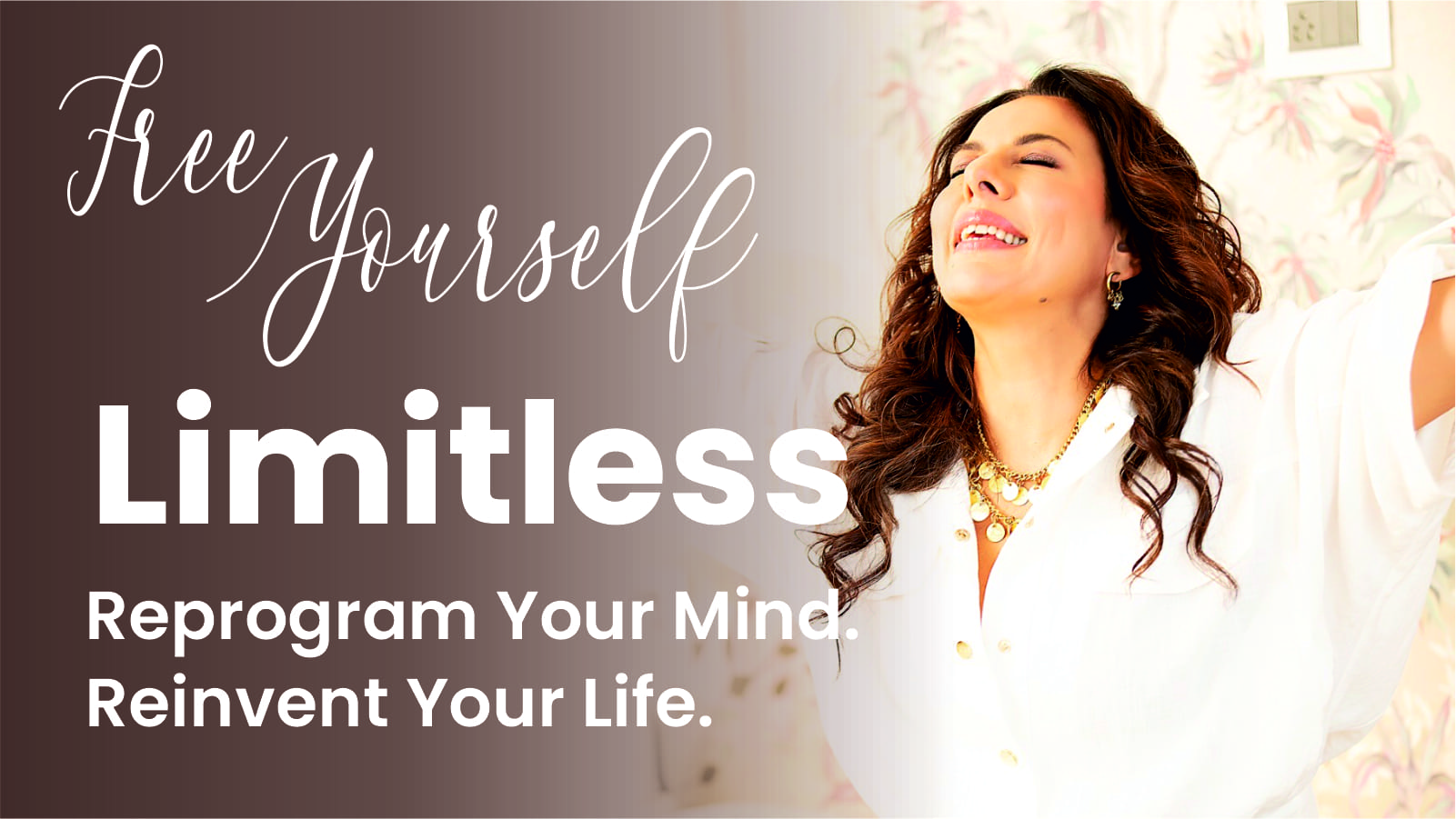
LIMITLESS is a transformative 12-week self-paced online course by Pooja Bedi, designed to help you reprogram your mind, overcome limiting beliefs and unlock your highest potential. Blending practical tools from NLP, clinical hypnosis, mindfulness, energy sciences and holistic wellness, the course empowers you to build confidence, cultivate a positive mindset and create lasting personal transformation. With engaging video lessons, guided meditations, exercises and access to a supportive community, LIMITLESS offers a step-by-step journey toward living with greater clarity, purpose, abundance and happiness.