Skip to content

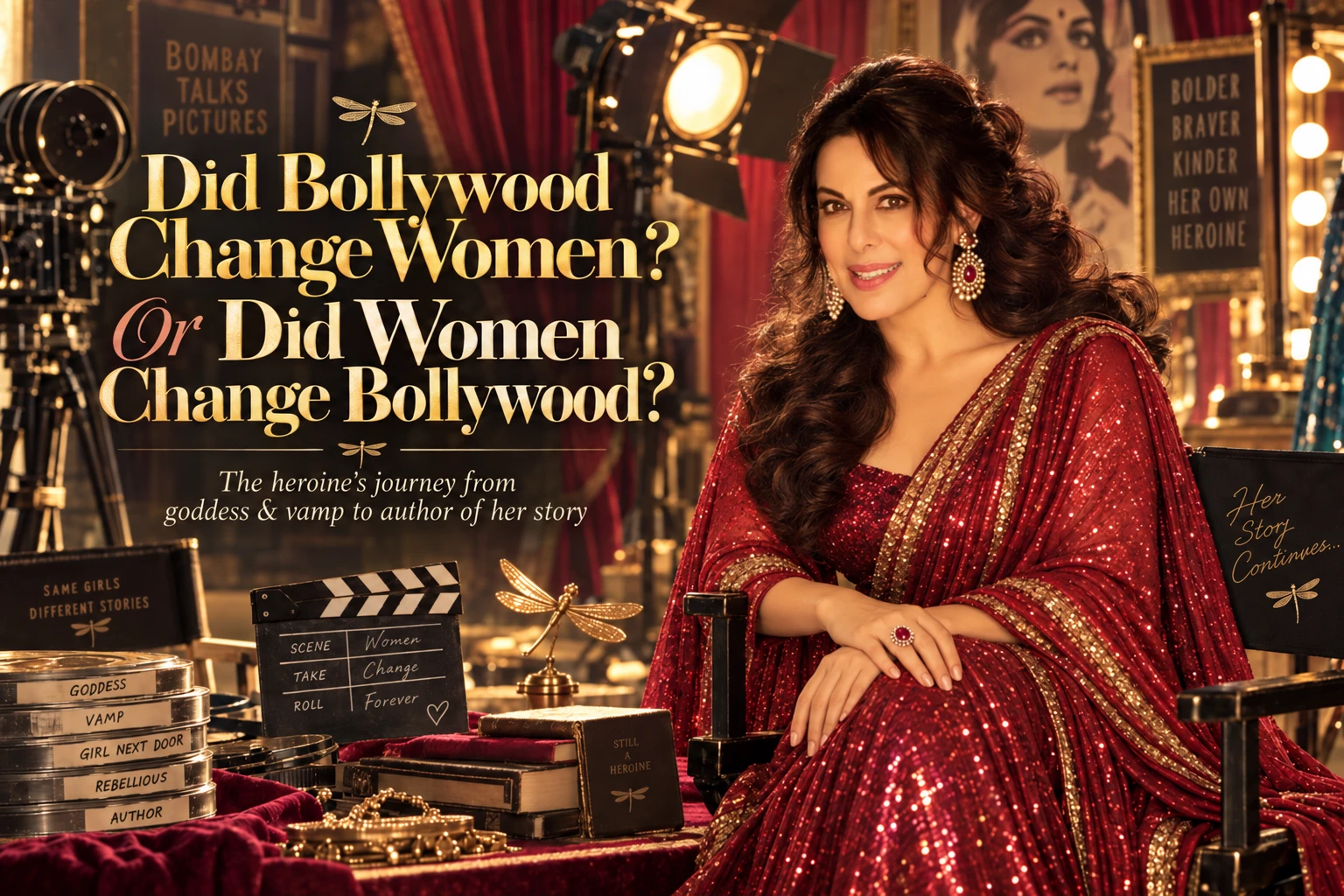
Did Bollywood Change Women? Or Did Women Change Bollywood?
She was once a goddess or a vamp, with almost no grey in between. In this piece, Pooja Bedi, who has stood on those sets as an actress herself, traces the Indian woman's journey from the edge of the frame to the centre of it, and finds in it a question about your own life too.

I want to tell you something from the inside.
I’ve stood on those sets. I acted in a Mahesh Bhatt film, was nominated for a Filmfare for Jo Jeeta Wohi Sikandar, and years later walked back onto screens to do death-defying stunts on national television while older women stopped me in malls to say I’d made them proud. So when I talk about how the Indian woman has been shown on our screens, I’m not analysing it from a film-studies classroom. I lived a version of it. I was, at various times, exactly the kind of woman the camera was deciding how to look at.
And from that vantage, I’ve watched her transform almost beyond recognition. She’s gone from suffering nobly at the edge of the frame to occupying the whole centre of it. From serving the hero’s story to finally having her own.
Which raises the question this piece is really chasing. Did our cinema change our women? Or did our women change our cinema? And underneath it: does a film hold up a mirror to society, or quietly hand society permission to change?
The Goddess, the Vamp, and No Grey
For a long time, the Indian heroine had two settings.
The good woman: virtuous, sacrificing, enduring, pure, often a stand-in for something larger, the nurturing mother as the newly independent nation, the Sita whose whole arc was suffering with dignity. And her opposite: the vamp, the other woman, who drank and danced and wanted things, and existed mainly to be punished by the final reel. Wife or vamp. Goddess or temptress. No grey in between, because grey is where real people live, and real people weren’t quite what the screen wanted yet.
Of course there were always magnificent exceptions, women who refused to behave neatly long before it was fashionable. But they stood out precisely because they were exceptions.
I wrote about this years ago, watching it shift, and put it a little cheekily: a modern-day Sita asked to walk across burning coals to prove her purity would most likely respond with “get a life,” divorce him, and if he really persisted, march him to the police station. A joke. But it was pointing at something true. The woman who proved her worth only through her suffering was on her way out.
What We Were Expected to Be
Let me make this concrete, because I was in it.
When I entered, an actress could not admit she had a boyfriend in real life. A screen kiss was considered scandalously bold. Public displays of affection were frowned upon, on screen and off. And here’s the detail that says everything: on screen, the hero could whistle at the heroine, tease her, chase her, and it was romance. The audience cheered. But the identical behaviour from the villain was harassment. Same act. The hero’s gaze made it love. The villain’s made it a threat. That was the water we swam in, and most of us didn’t even notice it was water.
Look how far that one thing has travelled. Today, eve-teasing on screen isn’t reframed as romance depending on who’s doing it. It’s simply not acceptable, full stop. That shift didn’t happen in a classroom. A great deal of it happened on screens, in front of families who slowly stopped clapping.
When She Finally Got Her Own Story
Over the past two decades, the change became undeniable. A woman went to find herself on her own honeymoon in Queen. Women became boxers, cops, spies. And recently the wave broke fully: Laapataa Ladies, Crew, women squarely at the centre, not the love interest, not the reward, the whole point.
Two shifts made it possible. First, who tells the stories. As more women gained real creative authority behind the camera, writing, directing, producing, women on screen began arriving through women’s eyes rather than only being framed for men’s. That is the difference between being looked at and being listened to. And before we congratulate ourselves too far, women still make up only a tiny fraction of mainstream Hindi film directors. Progress is real. So is the distance left.
Second, she’s finally allowed to be grey. Flawed. Ambitious. Angry. She can drink, want the wrong things, behave badly, and still be the protagonist rather than the cautionary tale. She gets to be a full human being instead of a goddess or a warning, which is all most of us ever wanted, on screen and off. Laapataa Ladies, directed by Kiran Rao, became India’s official submission for the 2025 Academy Awards, telling the story of ordinary rural brides with more truth than a hundred glossy heroines managed.
Perhaps the real victory will be the day nobody calls a film “female-centric” at all. Nobody calls an action film starring three men “male-centric.” It’s just a film. We may be inching toward that day. We’re not there yet.
Mirror, or Permission? And for Whom?
Before I answer which came first, I have to say something about India this conversation usually ignores.
We are not one society moving forward in tidy unison. We are living in several centuries at once. On the same day, in the same city, there is a woman in purdah and a woman in a bikini, and both are Indian, both are real, and both are “today’s woman.” Neither is a relic and neither is the finish line. They are simultaneous, sometimes at a single dinner table. That is the actual texture of this country.
So the change was never a gentle wave lifting everyone together. It arrived in some homes decades before others, and hasn’t reached many at all. Which is exactly what makes cinema’s role so interesting. The screen isn’t mirroring one settled reality. It’s mirroring all of them at once, and reaching the woman who was only ever taught to shrink, quietly showing her another way a life can look.
So which came first, the society or the story? Neither. It was a conversation, a decades-long back-and-forth between the screen and the street. Society shifted enough for audiences to accept a woman leading, and the films that dared it made the next shift feel a little more normal for the family watching in the dark. I saw this with something as simple as a stunt show. When families watched an ordinary woman do frightening, daring things, women told me it changed how they saw their own possibilities. The screen didn’t just reflect their courage. It gave them permission to find it.
And the permission was never really for the woman already free to shine. It was for the woman still held inside older patterns of patriarchy and subservience, the one taught so early and so thoroughly to dim herself, to take up less space, to serve and shrink, that she forgot it was a teaching rather than her nature. When she sees a woman on screen refuse to shrink, something loosens that no lecture could reach. That is cinema at its most powerful. Not decorating the lives of the already-free, but reaching the ones who forgot freedom was an option.
But honesty is the whole point of writing this from the inside. Not all the change is as deep as it looks. Sometimes what looks like liberation is objectification in an updated outfit, the same old gaze now wearing the language of empowerment. Progress can be genuine, or it can be packaging. A film can hand a woman a gun and a power suit and still film her exactly the way it always did. And the loudest declarations aren’t the truest, a heroine shouting “smash the patriarchy” into a microphone can move me less than a quiet tea-stall owner in a small film nudging a lost bride to become her own person. The revolution is usually quieter than the marketing.
So the real test was never whether a film stars a woman. It’s whether it sees her. Whether she’s the subject, or still, cleverly disguised, the object.
Here’s where the screen stops being about actresses and starts being about you. The question the heroine fought through is the one many of us are still living. Are you the author of your own story, or a supporting character in everyone else’s? Are you finally allowed to be grey, flawed, ambitious, fully human, or still performing the virtuous, enduring role someone cast you in long ago?
The heroine took decades to move from the edge of the frame to the centre. Most of us are somewhere in the middle of that same journey. And the good news is the same for you as it was for her. You don’t need anyone’s permission to become the protagonist of your own life. You only need to stop waiting to be cast, and start writing.
Learning to step out of the roles you were handed and finally author your own story is the whole heart of the work in LIMITLESS.
Frequently Asked Questions (FAQs)
How has the portrayal of women in Bollywood changed over the years?
Dramatically. For decades the Indian heroine was trapped in a binary: the virtuous, sacrificing woman, often a symbol of the nation itself, or the vamp who wanted things and was punished for it. There was almost no grey. Over the past two decades that has transformed. Women moved from the edge of the story to its centre, taking roles once reserved for men and, crucially, being allowed to be flawed, ambitious and fully human. There were always exceptions, remarkable complex women long before the recent wave, but they stood out precisely because they were exceptions. Now it is becoming the norm.
Does Bollywood reflect society or influence it?
Both, at once, in both directions. Cinema reflects a society that has shifted enough to want new stories, and those stories then give society permission to shift a little further. It’s a decades-long conversation between the screen and the street, not a one-way influence. This matters especially in India, which isn’t one society moving in unison but many, living in several centuries at the same time. So the screen isn’t mirroring a single reality. It reaches across all of them at once, and often speaks loudest to the woman still held inside older patterns, quietly showing her another way to live.
Are women-centric films in Indian cinema genuine progress or just a trend?
Largely genuine, though it’s worth staying clear-eyed. The shift is real: more women writing and directing has changed how women are filmed, from objects of beauty into subjects of a story, and heroines are finally allowed moral complexity. That the “female-centric” label is starting to feel unnecessary is a strong sign it’s more than a trend. But not all of it runs deep. Sometimes objectification simply wears the language of empowerment, and women still make up only a small fraction of directors. The honest test is not whether a film stars a woman, but whether it truly sees her.
What is the difference between the male gaze and the female gaze in cinema?
The female gaze isn’t simply a camera held by a woman. It’s a way of telling a story that gives a woman genuine subjectivity, an interior life, desire, agency and a point of view, rather than presenting her mainly as something to be looked at. A woman director can reproduce a male gaze, and a male filmmaker can create a deeply subjective female character. So the question was never only who holds the camera. It’s whose experience the camera asks us to inhabit, whether we’re watching a woman, or seeing the world through her.
Why does it matter how women are shown in films?
Because what we watch quietly shapes what we believe is possible. When the only women on screen are suffering saints or punished sinners, it narrows what girls in the audience imagine they can be. When women appear as full, flawed, ambitious people authoring their own lives, it widens that sense of possibility, and it reaches homes a lecture never could. Cinema doesn’t just entertain. It hands us models of who we might become. That’s why the move from the edge of the frame to its centre is about far more than movies. It’s about the stories we believe we’re allowed to live.

LIMITLESS is a transformative 12-week self-paced online course by Pooja Bedi, designed to help you reprogram your mind, overcome limiting beliefs and unlock your highest potential. Blending practical tools from NLP, clinical hypnosis, mindfulness, energy sciences and holistic wellness, the course empowers you to build confidence, cultivate a positive mindset and create lasting personal transformation. With engaging video lessons, guided meditations, exercises and access to a supportive community, LIMITLESS offers a step-by-step journey toward living with greater clarity, purpose, abundance and happiness.