Skip to content

You’re Not Who They Decided You Were
"I'm just not a confident person." "That's just who I am." We report these as facts, but they're verdicts, handed to us by our history, our labels and other people's expectations. In this piece, Pooja Bedi explores why identity is far more chosen than we admit, and why real reinvention isn't adding a new self but removing everything that was never you.

Listen to the way we describe ourselves sometimes.
“I’m just not a confident person.” “I’ve always been the anxious one.” “That’s just who I am.” “I’m bad with money, bad at relationships, bad at confrontation.” We say these things with a shrug, casually, the way you’d report your blood type or your height. As though they were simply facts about us, fixed and final, printed somewhere on our birth certificate.
But here’s what I want you to notice. Those aren’t facts. They’re verdicts. And almost none of them were actually handed down by you.
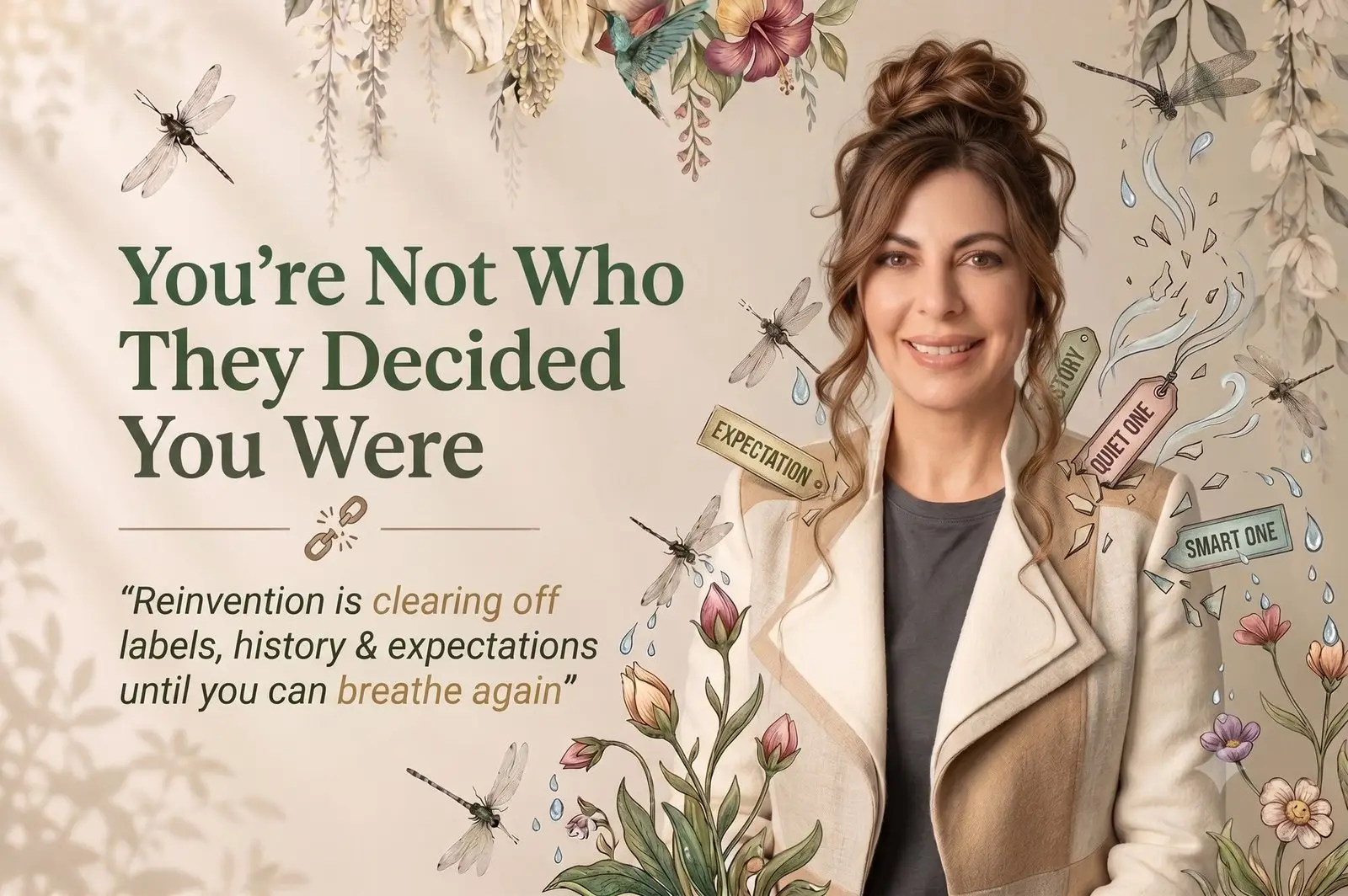
Somewhere along the way, someone or something decided who you were, and you accepted the ruling without appeal. A parent’s offhand comment. A label a teacher stuck on you at nine. An expectation your family draped over your shoulders before you were old enough to object. A story you told yourself after one bad experience and then never updated. And you’ve been dutifully living inside that verdict ever since, mistaking a sentence you were handed for a self you were born with.
I want to talk about that today. Because you are not obligated to keep being who your history, your labels, or other people’s expectations decided you would be. Underneath all of it, quieter than all of it, there has always been something else. Choice.
The Three Things Writing Your Story
Most of who we think we are was authored by three things, and it’s worth naming them, because you cannot rewrite what you cannot see.
The first is history. Your past is real, and it shaped you, I’d never pretend otherwise. But there’s a crucial difference between your past being the reason you’re a certain way and your past being the permanent sentence for how you must stay. History is data, not destiny. It explains where a pattern came from. It does not obligate you to keep running it for the rest of your life. Too many people treat one chapter of their story as though it were the whole book, already written, cover to cover, when in truth they’re still holding the pen.
The second is labels. We collect them like luggage. Religion, gender, nationality, class, the family role, the school reputation, the label a single relationship left on us. As I’ve written before, the same way boats weren’t built to sit in harbours, human beings were never meant to be confined to pools and groups and labels. Every label narrows the open sea of who you might be down to a manageable little pond, and then we mistake the pond for the ocean. Some labels are worth keeping. But you get to decide which ones, rather than wearing every tag anyone ever stuck on you as though it were your actual skin.
The third, and often the heaviest, is expectations. Other people’s scripts for you. The person your parents assumed you’d become, the role your partner slotted you into, the version of you your friends are comfortable with and quietly resist you outgrowing. Here’s something worth making peace with early: the world will never agree on who you are, and it certainly won’t agree on who you should be. Some will find you comforting, others challenging. Some will feel safe around you, others strangely unsettled by your growth. None of them has the whole map. If you wait for consensus before you become yourself, you will wait your entire life, and die having performed a part in everyone else’s play.
The Three Versions of You
Here’s a distinction I explore in LIMITLESS that quietly rearranges everything.
There are, in truth, three versions of you walking around at any given time. There’s the version others think you are. There’s the version you think you are. And there’s the version of who you actually are.
I love the old story of the blind men and the elephant. One touches the trunk and is certain it’s a snake. One feels a leg and insists it’s a tree. One grasps the tail and swears it’s a rope. Each is completely sincere, and each is completely wrong, because each has mistaken a part for the whole. That’s exactly how other people know you. They’ve felt one part of you, in one context, on one day, and confidently declared that to be the entire animal.
The trouble begins when we start believing their partial readings over our own knowing. We let the person who saw us in one anxious season convince us that anxiety is our whole nature. We let the boss who felt one bad quarter decide we’re a failure. We contort ourselves to match the fragment other people mistook for the whole, and slowly lose contact with the third version, the one that’s actually true.
You are not obligated to keep performing a role simply because others have grown comfortable watching you play it. You’re allowed to acknowledge the role, thank it for what it served, and set it down when you’ve outgrown it. That’s not a betrayal of who you are. It’s a return to it.
Reinvention Is Subtraction, Not Addition
Now here’s the part that genuinely changes how this feels, because most people get reinvention exactly backwards.
We imagine reinventing ourselves means becoming someone new. Adding things. A new personality, a better set of traits, a whole upgraded model of a human being, assembled from scratch through sheer effort. It sounds exhausting, frankly, and a little like self-rejection wearing a motivational T-shirt.
But that’s not what it is at all. As I say in LIMITLESS, a large part of reinvention isn’t about becoming someone new. It’s about removing everything that was never you in the first place.
Sit with that, because it’s a genuine relief. You don’t have to build a better self from raw materials. The self is already there, underneath. Reinvention is subtraction. It’s peeling away the borrowed beliefs, the inherited fears, the labels that never fit, the expectations you agreed to before you knew you were allowed to decline. It’s the F\#@\!-it list, as I’ve cheerfully called it elsewhere, not for abandoning what matters, but for finally releasing what never belonged to you, the pretence, the ego, the nagging need to be loved by those who never valued you, the exhausting desire to fit in when you were quite clearly made to stand out.
Underneath the person your history built, the labels you were given and the expectations you absorbed, there is someone remarkably specific and entirely yours. Reinvention is just clearing everything off them until they can breathe again.
And it comes down, in the end, to the one thing that was always yours. Your beliefs were passed down, not chosen. Your labels were assigned, not selected. Other people’s expectations were installed, not invited. But from here, from this moment on, you get to be the conscious editor of your own story. Not by rewriting your past, which is done, but by deciding what you carry forward from it.
So here is your invitation, and it’s smaller and more daily than you’d think. The next time you catch yourself saying “that’s just who I am,” pause and ask one honest question: is that actually true, or is it simply familiar? Is it me, or is it a verdict I never thought to appeal? You don’t have to overhaul your entire identity today. You just have to remember that you’re holding the pen. You always were.
Learning to separate who you were programmed to be from who you actually get to choose to become, and to reinvent yourself by subtraction rather than exhausting addition, sits at the heart of the LIMITLESS arc.
Frequently Asked Questions (FAQs)
Can you really change who you are, or is your personality fixed?
You can change far more than most people assume, because a great deal of what we casually call “personality” is actually accumulated conditioning, coping, belief and habit layered over temperament. Many of the traits we treat as permanent, being anxious, shy, bad with confrontation, were shaped by our history, the labels we were given and the expectations placed on us, none of which we consciously chose. Some temperament is genuinely innate, but the beliefs and patterns layered on top are far more changeable than they feel. You’re not rewriting your DNA. You’re deciding which of the inherited patterns you keep carrying forward.
How do I reinvent myself without losing who I am?
The reassuring truth is that real reinvention isn’t about becoming someone else, it’s about removing everything that was never you to begin with. Rather than building a new personality from scratch, which feels like self-rejection, you gently peel away the borrowed beliefs, inherited fears and labels that never fit. What’s left underneath isn’t a stranger, it’s the most authentic version of you, the one that was there before the world started editing. So you don’t lose yourself in reinvention. You actually find yourself, by subtracting everything that was quietly obscuring you.
Why do I feel trapped by other people’s expectations of me?
Because expectations are among the heaviest and least visible things we carry, often absorbed so early we mistake them for our own desires. The role your parents assumed you’d fill, the version of you your friends are comfortable with, the person your partner slotted you into, all of these can quietly script your life without your consent. Feeling trapped is often the gap between who you’re becoming and who others still expect you to be. The freeing realisation is that the world will never fully agree on who you should be, so waiting for their permission to change means waiting forever.
Is it too late to become the person I want to be?
It is almost never too late, and the belief that it is may itself be one of the inherited stories worth questioning. People treat one chapter of their lives as though it were the whole book already written, when in reality they’re still holding the pen. Your history explains how you got here, but it doesn’t dictate where you go next. Reinvention doesn’t require dramatic upheaval or a particular age. It begins with small, honest choices, made daily, about what you carry forward and what you finally set down. The pen was always in your hand.
What does it mean to reinvent yourself by choice rather than circumstance?
It means becoming the deliberate author of who you are, instead of the passive product of your past, your labels and other people’s expectations. Most people’s identities were assembled by circumstance, what happened to them, what they were told, what was expected. Reinventing by choice means consciously examining those inherited pieces and deciding which genuinely belong to you and which you’re ready to release. It’s the shift from “this is just how I am” to “this is who I’m choosing to become.” That shift, from verdict to choice, is where real personal freedom quietly begins.
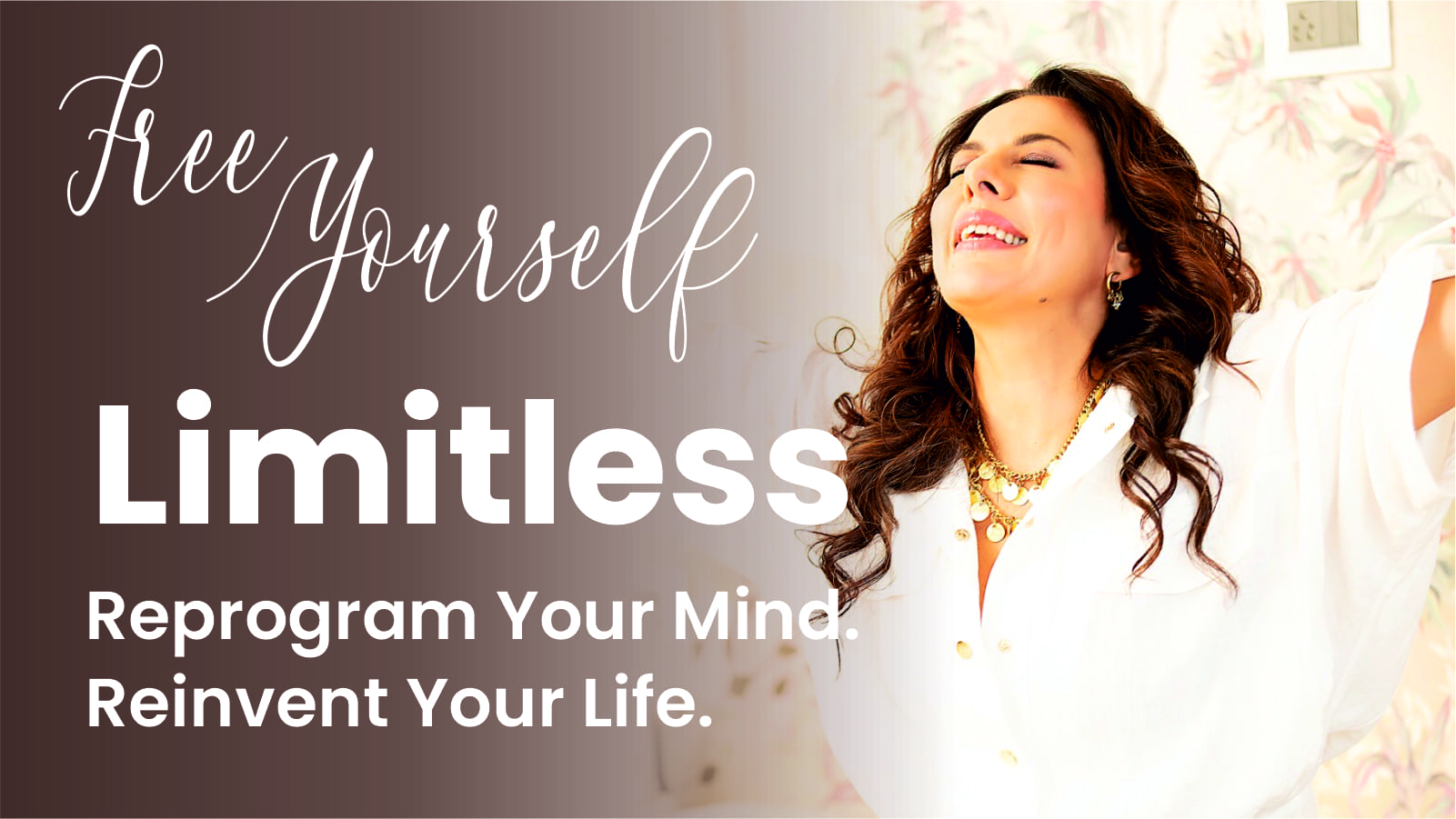
LIMITLESS is a transformative 12-week self-paced online course by Pooja Bedi, designed to help you reprogram your mind, overcome limiting beliefs and unlock your highest potential. Blending practical tools from NLP, clinical hypnosis, mindfulness, energy sciences and holistic wellness, the course empowers you to build confidence, cultivate a positive mindset and create lasting personal transformation. With engaging video lessons, guided meditations, exercises and access to a supportive community, LIMITLESS offers a step-by-step journey toward living with greater clarity, purpose, abundance and happiness.