Skip to content
Let me ask you something.
If happiness were a pill, would you take it?
Of course you would. Every morning. Same time, same dose, no excuses. You’d never skip it. You’d set a reminder. You’d panic a little if you ran out.
But happiness isn’t a pill. And because it isn’t, most of us treat it as something else entirely. We treat it as a mood. Something that arrives when the conditions are right, when the work is going well, when the family is behaving, when the weather is nice, when the bank balance cooperates, and vanishes the moment any of that shifts.
And that, quietly, is the great misunderstanding of most of our lives. We wait for happiness to happen to us, as though it were weather. When all along it was something closer to a muscle. Something you build. Something you practise until it becomes the way you are, rather than the way you occasionally feel.
And no, this does not mean pretending pain does not exist. It does not mean smiling through grief, bypassing anger or decorating a difficult life with affirmations. Some days are genuinely hard. Some seasons are brutal. But even inside those seasons, there are small inner practices that decide whether your mind becomes a prison, a battlefield or eventually, slowly, a place you can live in again.
I want to talk about that today. Because once you understand that happiness is a practice and not a mood, everything changes.
Your Brain Was Never Wired for Happiness
Here is something worth knowing, and it isn’t the flattering version.
Your brain is not wired for happiness. It is wired for repetition. Worry can become automatic. So can comparison. So can irritation. Not because you are flawed, but because the brain loves whatever is familiar. It keeps returning to the emotional roads you have travelled most often.
Notice what this means. Complaining comes on its own. Finding a solution has to be chosen. Anger needs no invitation but staying calm has to be chosen. Kindness toward yourself has to be chosen. But chosen often enough, even these begin to feel less like effort and more like home.
This is not wishful thinking. It’s neuroplasticity, the well-established finding that the brain physically rewires itself based on what you repeat. Whatever you repeatedly practise becomes easier for your brain to return to. In everyday language, you become fluent in the emotional states you rehearse most. In LIMITLESS I describe happiness as exactly this: not a feeling you wait for, but a state you train.
So the only real question is: what have you been practising?
Because if you’ve spent years rehearsing stress and comparison, you have become extraordinarily good at them. And the beautiful, slightly inconvenient truth is that you can become just as good at joy. It simply requires the same thing. Anything worth having requires. Practice.
You Don’t Find Happiness. You Filter For It.
Two people go to the same dinner party. One leaves noticing everyone who ignored them, the friend who seemed distant, the comment that stung. The other leaves remembering the person who laughed with them, the lovely dish, the warmth of a good conversation.
Same room. Same evening. Two completely different realities. The difference wasn’t the party. It was the filter.
I’ve travelled to remote villages in India where material comfort is limited and hardship is very real. I would never romanticise that. And yet, I have also seen laughter, generosity and joy there in ways that remind me happiness is not handed out only to those with the right postcode, bank balance or thread count. It doesn’t mean those lives are free of difficulty. Every single day brings some reason to be disturbed. So here is what I’ve come to understand: a happy person is not someone with an absence of problems. A happy person is someone who is actively generating happiness by finding reasons for it.
Moments make us happy. People make us happy. Money, experiences, love, all of it makes us happy. And the very same moments, people, money, experiences and love can make us miserable too. The variable was never the thing. It was what you chose to dwell on and amplify.
Your boss snaps at you. The unpleasantness is real. I am not asking you to put a marigold garland around bad behaviour and call it growth. But you do get to decide whether that one moment becomes the only reality your mind rehearses for the rest of the day. You can address what needs addressing, and then deliberately refill your attention with other sources of life…. the good meal, the child’s laugh, the friend who checked in or the small mercy you nearly missed.
Your brain treats whatever you repeatedly notice as reality. Which is precisely why your inputs matter so much. Your conversations, your media feed, the company you keep, all of it is quietly training your default. Choose the inputs. You’re programming yourself either way.
Gratitude Is Not Cute. It’s Power.
We have made gratitude far too soft. We’ve turned it into a polite little habit, a thank you, universe, a nice thing to remember before a meal as grace, or at bedtime.
Let me offer you a different definition. Gratitude is one of the simplest and most repeatable tools I know for changing your internal state. It interrupts the feeling of lack. It trains the brain to register enough. When you genuinely feel grateful, you are not denying what is missing. You are reminding your nervous system that not everything is missing.
When you feel grateful, you are telling your body: I am safe, I have enough. And the nervous system responds by relaxing, opening, allowing. That is not only sentiment. It has physiology beneath it. There’s a lovely distinction I hold close: gratitude is when you count your blessings. Jealousy is when you count the blessings given to others. Same act of counting. Opposite frequency entirely.
I think of gratitude as a kind of vaccine. It protects me from negativity, from comparison, from emotional instability, and it amplifies joy, presence and a sense of abundance. But like any practice, it only works if you actually do it. Not occasionally. Not when you happen to feel like it. Daily.
This is what I call blisscipline in LIMITLESS, the discipline of bliss. Because here’s what nobody warns you about. You can do all the inner work, understand your patterns, have every insight, and then life quietly creeps back in. Not dramatically. Not through some grand failure. Just through inconsistency. One bad day, one trigger, one difficult person, and you’re back to your old default. The work was never the finish line. The practice is.
So make it small and make it daily. Choose the state you wake up in and the state you fall asleep in. Notice the good meal, the kind word, the small mercy. Say the affirmation even when you don’t quite believe it yet. Catch yourself before the grumble and ask whether complaining has simply become a habit. And feel gratitude on purpose, especially on the days it feels least available, because those are precisely the days it does the most work.
Happiness was never going to arrive like the weather. It was always going to be built, one deliberate choice at a time, until the choosing began to feel like you.
You have everything you need to begin. Not tomorrow, when things calm down. Now, in the middle of the mess, exactly as you are.
If this is something you want to practise more consciously, the happiness, gratitude and blisscipline work inside LIMITLESS takes it much deeper. Not as a theory. As daily inner training so that happiness becomes less of an occasional visitor and more of a place you know how to return to.
Frequently Asked Questions (FAQs)
Is happiness a choice or something that just happens to you?
Happiness is partly a choice, but not in the simplistic “just be happy” way people throw around. Life can be painful, unfair and genuinely difficult, and some circumstances are beyond our control. But the emotional state you return to most often is shaped by what you repeatedly practise, notice and feed. Your brain is wired for repetition, not for happiness, which means whatever you rehearse most becomes your default. In that sense happiness is less something that happens to you and more something you build over time.
What’s the difference between pleasure and happiness?
Pleasure is immediate and fleeting. Happiness is sustainable. Pleasure says “I want more,” and the pursuit of more is exhausting and never quite satisfied. Happiness says “this is wonderful,” and it’s available right now without needing to escalate. Pleasure can feel wonderful until it costs you everything, while happiness builds you rather than depleting you. The two are easily confused, but learning to tell them apart is one of the most useful distinctions you can make.
How do I train myself to be happier day to day?
Start with small, repeatable daily practices rather than waiting for a dramatic transformation. Choose the state of mind you wake up with and go to sleep with. Deliberately notice what’s good, because your brain treats whatever you repeatedly notice as reality. Practice gratitude on purpose, especially on difficult days, and watch your inputs, since your conversations, media and company all quietly train your default. Happiness is a muscle, and these are the reps.
Why am I not happy even though nothing is wrong in my life?
Because happiness was never about the absence of problems, and having nothing obviously wrong doesn’t automatically generate joy. A happy person is not someone with a conflict-free life. A happy person is someone actively generating happiness by finding reasons for it. If your baseline has been trained over years towards comparison or a low hum of dissatisfaction, that default will persist even when your circumstances are objectively fine. The work is not to fix your life. It’s to retrain what your mind habitually notices and amplifies.
Can you actually rewire your brain to be happier?
Yes, and this is grounded in neuroscience rather than motivational language. Neuroplasticity means the brain reshapes itself based on what you repeatedly think, feel and do. Every time you choose calm over reactivity, or gratitude over lack, you make that response a little easier to return to. It isn’t instant and it isn’t always easy, because you’re working against defaults that took years to form. But with consistent daily practice, a happier baseline is genuinely trainable. You are always programming yourself. The only question is whether you’re doing it consciously.
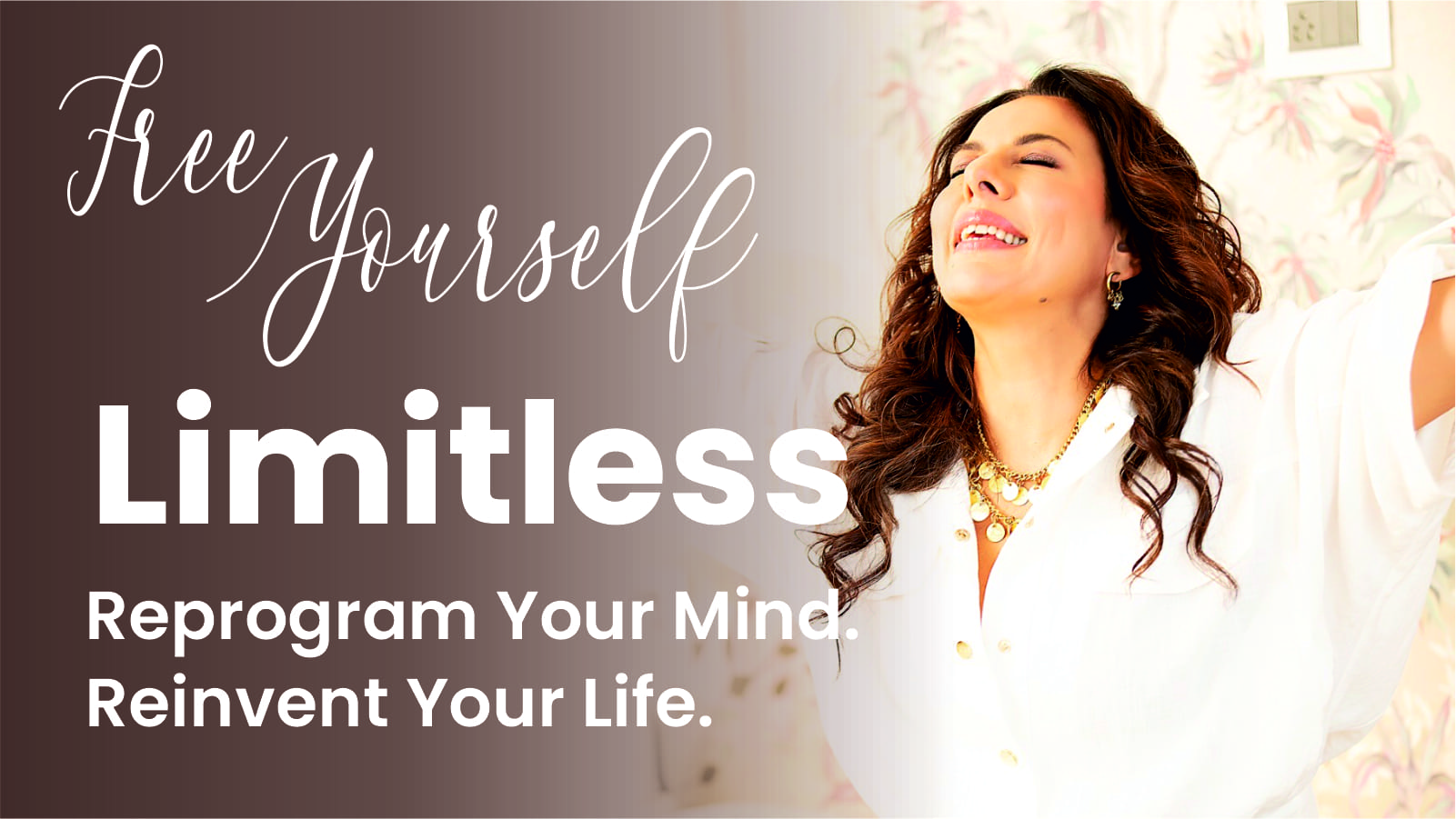
LIMITLESS is a transformative 12-week self-paced online course by Pooja Bedi, designed to help you reprogram your mind, overcome limiting beliefs and unlock your highest potential. Blending practical tools from NLP, clinical hypnosis, mindfulness, energy sciences and holistic wellness, the course empowers you to build confidence, cultivate a positive mindset and create lasting personal transformation. With engaging video lessons, guided meditations, exercises and access to a supportive community, LIMITLESS offers a step-by-step journey toward living with greater clarity, purpose, abundance and happiness.