Skip to content
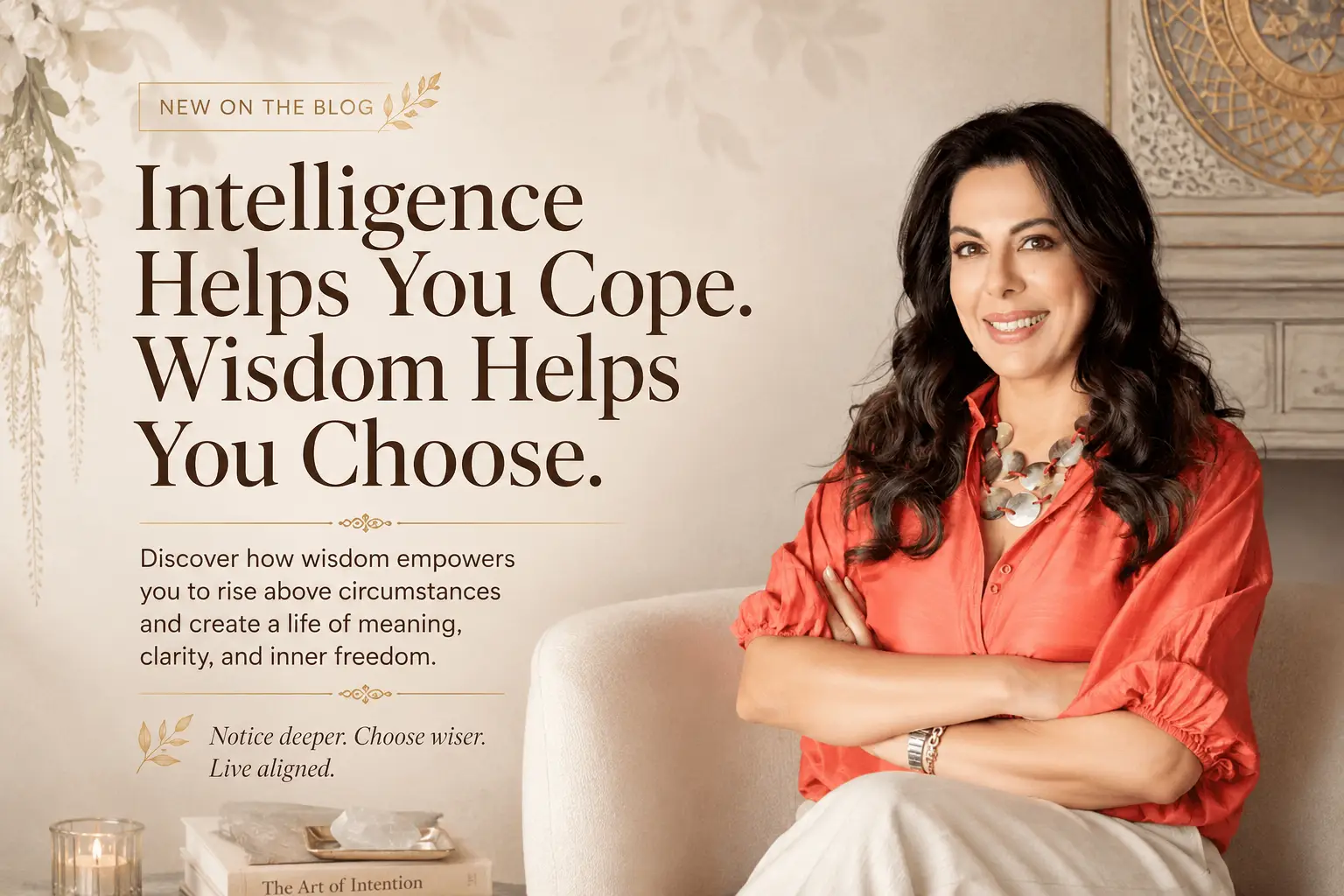
Intelligence Helps You Cope. Wisdom Helps You Choose.
You don't need more information. You need a different question. In this piece, Pooja Bedi explores why high-achieving people stay stuck despite doing everything right, and what the shift from intelligence to wisdom actually looks like in daily life.You don't need more information. You need a different question. In this piece, Pooja Bedi explores why high-achieving people stay stuck despite doing everything right, and what the shift from intelligence to wisdom actually looks like in daily life.

There is a particular kind of exhaustion that high-achieving people carry. It’s not the tiredness that sleep fixes. It’s the tiredness of someone who has spent years being brilliant at navigating a life they never stopped to question.
They have read the books. Attended the workshops. Googled the symptoms. They can articulate their patterns with impressive precision… and then repeat those patterns anyway. They are, in every sense of the word, intelligent people. Wonderful, capable, often extraordinary people.
And yet.
Something isn’t working. Not visibly. Not in a way anyone would notice at a dinner party. But somewhere inside, they know. The life they’ve built is functional. It just doesn’t feel like theirs.
The Coffee Cup Nobody Talks About
I want to start with a question I love asking.
You’re carrying a cup of coffee. The lid isn’t on quite tight enough. Someone rushes through a door, bumps into you, and… coffee everywhere.
Why did the coffee spill?
Go on. Think about it for a moment.
Because of the person who bumped you? Because the lid was loose? Because you were holding it at an angle? Because it was too hot?
Here’s the only answer that actually matters: the coffee spilled because there was coffee in the cup.
You can only spill what you’re carrying.
And this, quietly, is the most important thing I can tell you about the difference between intelligence and wisdom. Intelligence will spend considerable energy analysing the person who bumped you, the quality of the lid, the temperature of the coffee, and what you should have done differently. Wisdom asks: what am I carrying in the cup?
Same situation. Entirely different question. Entirely different life.
You’ve Been Asking the Wrong Questions
Here is something worth sitting with. Most of the questions we ask ourselves are intelligent questions. They are logical, practical, solution-focused. They just happen to be answering the wrong problem.
An intelligent question sounds like: “How do I stay calm when I feel disrespected?” So you download a breathwork app. You count to ten. You buy a journal. You manage the moment beautifully.
A wise question sounds like: “Why am I continuing to stay in environments that repeatedly cross my boundaries?”
Do you feel the difference? One manages the symptom. The other addresses the source.
Intelligence comes from the mind. It analyses data, argues a point brilliantly, finds workarounds, and keeps things running. This is genuinely useful. Intelligence got you here. Hats off to it.
But wisdom… wisdom comes from something larger. It comes from the integration of mind, heart, body, and soul working together, not just the part of you that processes information fastest.
Wisdom sees the larger picture. And sometimes, the most powerful shift isn’t finding a better answer. It’s realising you’ve been asking the wrong question all along.
Think about the last time you had a significant problem in your life. Whether it was a relationship that kept recycling the same argument, a career that felt increasingly hollow, a pattern of people-pleasing you couldn’t seem to stop. Chances are you found very intelligent solutions. You communicated better. You set goals. You read the right books. You talked to the right people.
And yet the problem kept showing up, perhaps wearing a slightly different outfit, but recognisably the same problem.
That’s not a failure of intelligence. That’s intelligence being asked to solve something that only wisdom can reach.
What Integration Actually Means
Here’s where it gets interesting. And where most personal growth conversation stops short.
We are not just thinking machines. Neuroscience has now confirmed what ancient wisdom traditions have always known: the body keeps score, emotions carry information, and the subconscious mind, which runs approximately 95% of your daily behaviour, doesn’t respond to intellectual argument.
You cannot think your way out of a pattern that wasn’t installed through thinking.
Your subconscious mind stores memories, runs habits, manages emotional reactions, and holds the belief systems that were programmed into you, mostly before the age of seven, long before you had the cognitive ability to question any of it. When you try to change your life using only your conscious mind, that magnificent analytical part of you that makes plans and sets intentions, you are essentially trying to renovate a building by rearranging the furniture. The structure underneath remains untouched.
Wisdom, true wisdom, works differently. It asks the body what it’s holding. It listens to the emotional signal underneath the reaction rather than immediately trying to manage the reaction. It sits with discomfort long enough to hear what the discomfort is actually saying, rather than reaching for the nearest intelligent solution to make it stop.
This is not soft. This is not esoteric. Stanford researchers found that simply shifting what people believed about their situation changed measurable biological outcomes, including blood pressure, body composition, and hunger hormones, without changing a single behaviour. Hotel workers told that their daily work counted as exercise became physically healthier. Patients given placebos and told they would feel better reported less pain, used fewer medications, and recovered faster.
Their body didn’t change first. Their perspective did. And the body followed.
That is wisdom in action. Not smarter thinking. Integration.
The Question Worth Asking Today
So here is the practical invitation, and it is a simple one.
Pick one area of your life that feels stuck, frustrating, or quietly joyless. Not a crisis. Just that low hum of this isn’t quite right that you’ve perhaps been managing rather than addressing.
Now ask yourself two versions of the question.
First, the intelligent version: what should I do about this?
Notice what comes up. Plans, strategies, things to research, people to call. Valid. Useful. Not the whole story.
Then ask the wise version: what is this situation trying to show me about what I’m carrying?
Sit with that one a little longer. The answer that comes from that question… that is where actual change begins. Not the change that looks good on the outside. The change that feels different on the inside.
Limitless is not about becoming more intelligent. It’s about becoming more integrated. Because intelligence helps you cope. Wisdom helps you choose. And if you want to go deeper into exactly how that integration works, how to access the layers of your mind that intelligent thinking alone can’t reach, that’s precisely what we explore inside LIMITLESS.
Frequently Asked Questions (FAQs)
What is the difference between intelligence and wisdom?
Intelligence is the mind’s ability to analyse, problem-solve, and navigate situations effectively. Wisdom is what happens when the mind, heart, body, and soul work together rather than the thinking brain working alone. An intelligent person finds better answers. A wise person questions whether they’re asking the right question in the first place. Both matter, but only one of them reaches the deeper layers where real change lives.
How do I know if I’m solving the wrong problem in my life?
The clearest sign is repetition. If the same kind of situation, the same argument, the same pattern, the same feeling of being stuck, keeps showing up in different forms across different areas of your life, you are likely addressing the symptom rather than the source. Intelligent solutions manage the moment. Wisdom asks what created the moment, and what you might still be carrying that keeps recreating it.
Can I develop wisdom, or is it something you either have or you don’t?
Wisdom is absolutely developed, and it begins the moment you start asking different questions. It deepens through honest self-reflection, through working with the subconscious rather than against it, through learning to listen to emotional and physical signals rather than immediately managing them. Nobody is born wise. Wisdom is intelligence that has learned to be humble enough to look inward.
Why do intelligent people sometimes feel the most stuck?
Because intelligence is extraordinarily good at keeping things functional. It finds workarounds, manages discomfort, builds impressive coping strategies, and keeps life running smoothly on the surface. The very capability that makes intelligent people successful also makes it easier to avoid the deeper inquiry that would actually shift things. It’s not a character flaw. It’s intelligence doing exactly what it was designed to do. The invitation is simply to bring something else into the conversation alongside it.
What does it mean to integrate mind, heart, body, and soul?
It means making decisions from a place where all four are in conversation rather than the mind overruling everything else. Your thoughts, your emotional signals, your physical sensations, and your deeper sense of what is true for you at a soul level, these are four distinct streams of information. Integration is learning to hear all four rather than defaulting to the loudest one. For most high-achieving people, that loudest one is the analytical mind. Wisdom is giving the others a seat at the table.
LIMITLESS is a transformative 12-week self-paced online course by Pooja Bedi, designed to help you reprogram your mind, overcome limiting beliefs and unlock your highest potential. Blending practical tools from NLP, clinical hypnosis, mindfulness, energy sciences and holistic wellness, the course empowers you to build confidence, cultivate a positive mindset and create lasting personal transformation. With engaging video lessons, guided meditations, exercises and access to a supportive community, LIMITLESS offers a step-by-step journey toward living with greater clarity, purpose, abundance and happiness.